Top Software Development Outsourcing Trends for 2026

By 10Pearls editorial team

A global team of technologists, strategists, and creatives dedicated to delivering the forefront of innovation. Stay informed with our latest updates and trends in advanced technology, healthcare, fintech, and beyond. Discover insightful perspectives that shape the future of industries worldwide.

In 2026, software development outsourcing trends are shifting towards strategic AI-enabled partnerships, rather than
simply cost-driven delivery. Organizations are looking for outsourcing partners that support modernization at scale,
cloud-native platforms, secure AI adoption, and measurable business outcomes. These trends shape how organizations
select partners, structure their engagements, and accelerate digital transformation.
Software
development outsourcing
helps companies overcome talent shortages while releasing innovative products. Whether
through a software outsourcing company or IT staff augmentation, the industry is constantly evolving to meet
businesses’ changing needs. This guide discusses 10 of the top software development outsourcing trends for 2026 and
offers advice on how to stay ahead of the curve.

Two developers looking at a laptop and looking through the top software development outsourcing trends.

Software development outsourcing industry statistics and insights

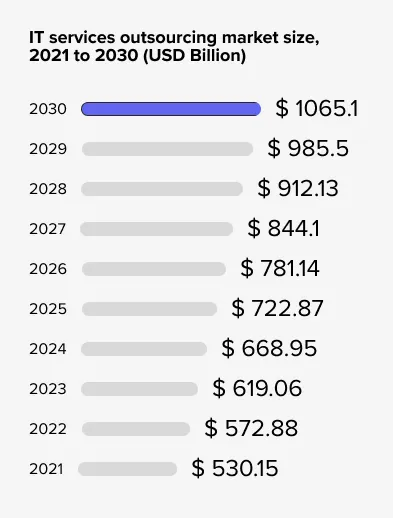
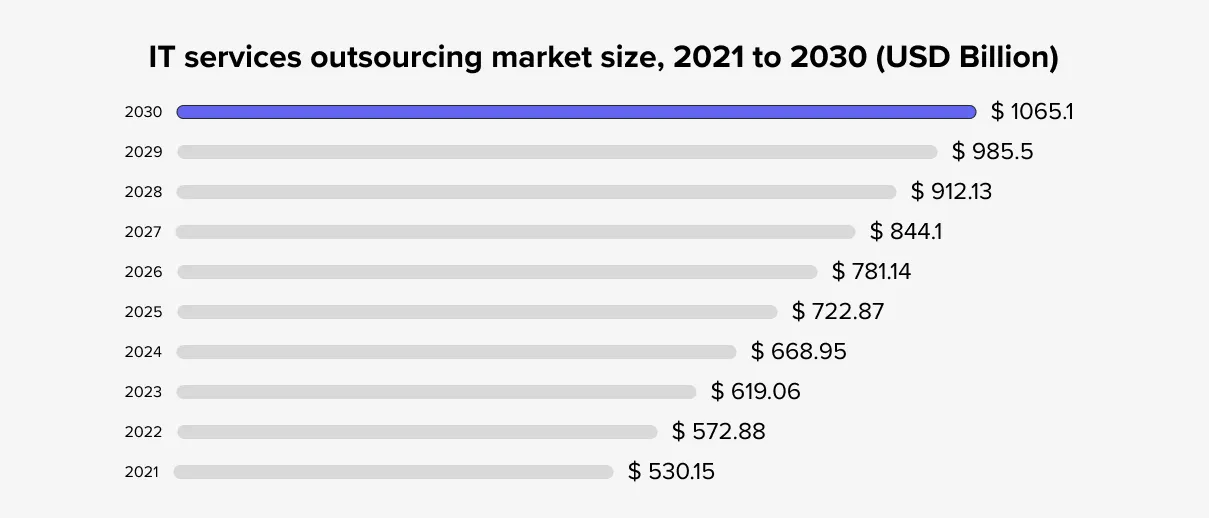
  • The IT and software outsourcing industry is experiencing explosive growth. According to Mordor Intelligence, the market is currently valued at $613.69 billion. Precedence Research predicts it will grow to $1.06 trillion by 2030.

Bar graph showing the market size of outsourced IT services from 2021 to 2030
  • According to one survey, 66% of businesses in the United States outsource at least one department, highlighting how prevalent talent shortages are across sectors and business functions.

  • The U.S. Bureau of Labor Statistics estimates the demand for software developers, testers, and QA experts to grow by 22% in 2030, making them the fastest-growing occupations in the country.

Top software development outsourcing trends for 2026

Here are the trends that are moving the software development outsourcing industry forward in 2026 and beyond.

AI and automation integration

AI-augmented development will continue to be leveraged more widely, becoming standard practice rather than occasional experimentation. Enterprises increasingly rely on AI, automation, and intelligent agents across the software development lifecycle to accelerate delivery, improve quality, and enhance operational efficiency. According to a Deloitte survey, 83% of executives are incorporating AI in their outsourcing service delivery. From automated code generation and testing, to intelligent monitoring, analytics and optimization, AI enables faster time-to-market, lower defect rates, and software systems designed and built to evolve alongside business needs.

Cloud-native architecture and services

Cloud-native architecture will remain a priority for organizations as they look to modernize and future-proof their systems while integrating legacy platforms with modern API-driven environments. Outsourcing companies with strong expertise in AWS, Azure and Google Cloud can design and implement microservices, containerized platforms, and managed cloud services that improve scalability, resilience, and performance. Cloud-native delivery enables faster innovation cycles, better cost control, and the flexibility required to support AI workloads, data-intensive applications, and global digital platforms.

Security and data protection

As cyber threats grow in scale and complexitysecurity and data protection are critical outsourcing priorities in 2026Experienced and certified outsourcing partners embed security into every layer of architecture and delivery through zero-trust principles, DevSecOps practices, and compliance-by-design. This approach reduces risk exposure, protects sensitive enterprise data, and ensures regulatory alignment and compliance while enabling organizations to innovate and scale confidently. 

Flexible engagement models

Enterprises require outsourcing models that are responsive and adaptable to changing business priorities and market conditions. Flexible engagement models (including dedicated teams, hybrid delivery, and outcome-based structuresallow organizations to scale resources efficiently while maintaining strategic oversight. This flexibility helps enterprises optimize investment, reduce vendor lock-in, and respond quickly to evolving transformation initiatives without sacrificing quality. 

Agile and DevOps maturity

Enterprises expect outsourcing partners to deliver beyond basic agile adoption, with advanced CI/CD pipelines, infrastructure as code, and automated quality assurance. Mature DevOps practices enable faster releases, improved reliability, and continuous feedback. This allows organizations to respond rapidly to user needs while maintaining stability across complex, enterprise-scale systems. 

Low-code / no-code platforms

Organizations seeking faster application delivery will turn to low-code and no-code platforms to accelerate development, reduce dependency on scarce engineering resources, and empower business teams to participate in solution design. When outsourcing partners leverage and implement these platforms with proper governance and integration, low-code solutions reduce costs, shorten delivery times, and support scalable, enterprise-grade innovation. 

Blockchain technology

Blockchain adoption in 2026 extends beyond digital currencies into enterprise use cases that require trust, transparency, and security. Outsourcing providers implement blockchain solutions for areas such as supply chain traceability, identity management, and secure transactions. These decentralized systems improve data integrity, reduce fraud, and enable greater transparency across ecosystems. This supports regulatory compliance and more efficient, reliable digital operations. 

Digital transformation acceleration

Choosing the right outsourcing partner is a key strategic decision in terms of accelerating digital transformation initiatives. Enterprises increasingly seek providers that combine software engineering, AI integration, and modernization expertise to drive measurable outcomes. This integrated approach helps organizations modernize legacy platforms, reduce technical debt, and unlock new digital capabilities faster. This supportlong-term growth, operational resilience, and competitive advantage. 

Demand for specialized skills

Demand for specialized skills continues to rise in 2026 as technologies evolve rapidly. Outsourcing enables enterprises to access scarce expertise in areas such as AI, data engineering, cloud platforms, cybersecurity, and industry-specific systems. This access reduces time-to-execution, addresses talent shortages, and allows organizations to deliver complex, high-impact initiatives without the cost and delay of long recruitment cycles. 

Cost optimization through value creation

Cost optimization remains a key outsourcing driver in 2026, with a stronger focus on long-term value creation. Leading outsourcing partners optimize architectures, modernize platforms, and automate workflows to reduce total cost of ownership. Rather than short-term labor savings, enterprises achieve sustainable cost efficiency through improved performance, scalability, and reduced maintenance overhead across their digital ecosystems

Prioritizing quality talent over cost savings

Cost has long been the biggest driver for IT outsourcing, with recent research finding that 59% of U.S. businesses cite it as the top factor leading them to outsource. In 2026, however, organizations are focusing less on getting the lowest possible price and more on finding the right talent for their project, prioritizing quality over cost to achieve better outcomes. Moving forward, companies will look for ways to increase the value of their outsourcing engagements by working with firms that lower costs through efficient development practices and innovative ideas while still providing top-quality talent.

Augmenting teams with niche expertise

Modern software projects often require developers with niche expertise in specific programming languages or technologies, which can be a huge hurdle for companies dealing with tech talent shortages. According to Deloitte, 50% of executives say that talent acquisition is a top internal challenge in meeting their company’s strategic priorities.
Bar graph showing the top internal challenges that organizations face.

IT staff augmentation is an outsourcing engagement model that involves hiring one or more outside experts, whether in mobile app development or QA testing to fill specific gaps in a development team. Moving through 2026, this strategy will help organizations find the niche expertise they need to achieve their visions and strengthen their competitive edge. 

Placing greater emphasis on cybersecurity

Working with outside vendors increases your attack surface or the number of potential vulnerabilities a malicious actor could exploit to gain access to your sensitive data. Attacks on third-party vendors are known as supply chain attacks, and according to Gartner, 45% of global organizations will be affected by one by the end of 2026. Due to these and other cybersecurity risks, companies are placing a far greater emphasis on data security in their outsourcing engagements, preferring to work with trusted firms that hold industry certifications and have experience with security and privacy compliance. In 2026, companies will also continue prioritizing security by seeking outsourcing partners that offer long-term maintenance and support contracts to handle things like CVE (common vulnerabilities and exposures) monitoring and vulnerability patching.

Onshore and nearshore outsourcing

Offshore outsourcing has long been the preferred strategy for getting a software project completed at the lowest possible cost. However, as priorities shift to quality over savings, the nearshore and onshore outsourcing models are gaining popularity. Onshore outsourcing enables close collaboration between teams who share language fluency and workplace norms — making it ideal for regulated sectors like healthcare software development or fintech software development that demand a high level of compliance and security. Nearshore software development offers a cost compromise between offshoring and onshoring, involving collaboration with a team that’s geographically (and culturally) close while still being in another country.   

Comparing popular nearshore outsourcing locations

CountryHourly rateHighlights
Costa Rica $25-$100
  • Time zone overlaps with U.S. Central Time
  • Stable government invests heavily in education
  • Affordable hourly rates
  • Supports major tech companies like Intel, IBM, and HP
Argentina
$25-$45
  • Over 100,000 developers
  • Highly educated population
  • Time zone similar to U.S.
  • Highest level of English in LATAM
Colombia
$15-$40
  •  62,000+ software developers
  • Competitive hourly rates
  • Has some of the best universities in LATAM
  • Time zone overlaps with U.S. Eastern Time
Peru 
$15-$50
  • 38,000+ software developers
  • Time zone overlaps with U.S. Eastern Time
  • Competitive hourly rates
  • High employee retention rate

Nearshore and onshore strategies help companies overcome talent shortages and still save some money while offering a smoother development process and, usually, superior results.

Low-code and no-code development

Low-code and no-code development platforms allow users to build or modify a software application using GUI (graphical user interface) tools while requiring little to no actual coding. An example would be website-building tools like Squarespace that use templates and drag-and-drop elements instead of making users write HTML code. In 2026, more outsourcing firms will make use of low-code and no-code platforms to significantly streamline the development process and accelerate releases without sacrificing features or quality. They will also use these tools to provide clients with the ability to easily update and maintain their own software without expensive or time-consuming support requests.  

AI, machine learning, and data science

Artificial intelligence, machine learning, and data science are rapidly altering the business landscape. Companies partnering with an AI consulting company or adopting custom AI solutions are pulling ahead of those that don’t integrate these technologies

According to a Deloitte survey, 59% of all IT outsourcing is focused on AI and machine learning consulting, and this number is expected to continue growing in 2026. The same survey found that 50% of companies are unprepared for the challenge of next-generation technology skill shortages, especially in the areas of data science and AI/machine learning.

Graphs showing 59% of IT outsourcing is focused on during AI/ML consulting and 50% of companies are unprepared for skill shortages

Green technology and sustainability

As global concerns over climate change and other environmental issues continue to rise, forward-thinking companies are addressing their customers’ worries by seeking ways to reduce their carbon footprint through technology. This includes looking for outsourcing partners who demonstrate sustainability through environmentally friendly practices like shutting down dev instances during off-hours, considering energy consumption when coding new features, and monitoring real-time power consumption through dynamic code analysis. Additionally, businesses are turning to outsourced talent to help develop more sustainable AI solutions and other advanced technologies. 

Hybrid engagement models 

Businesses are seeking greater flexibility in working with outsourcing partners so they can better adapt to the complexities and ever-changing requirements of modern software projects. In 2026, software development outsourcing firms are offering more hybrid engagement models to better suit the unique needs of each individual client.  

For example, 10Pearls uses a right-shoring strategy that combines offshore, custom software development services, and nearshore talent according to each project’s requirements. That might mean consulting with nearshore experts for the initial design, outsourcing to a less-expensive offshore team for coding, and then working closely with an onshore team for QA and compliance. This approach helps to reduce costs where possible while still providing the quality expertise and close collaboration needed for mission-critical processes.

Comparing software development outsourcing models

Outsourcing modelProsCons
Offshoring
  • Often significantly less expensive than other models
  • Large overseas talent pools make staffing quick and easy
  • Language fluency may vary by team
  • Time zones pose challenges for real-time oversight & collaboration
Onshoring
  • Provides greater control over development and security
  • Language fluency, proximity, and workplace cultures facilitate easy collaboration
  • Typically more expensive than other models
  • High demand for tech talent makes it harder to find onshore experts
Nearshoring
  • Overlapping time zones and languages permit smoother collaboration
  • Provides access to a large and highly educated tech talent pool
  • Regional instability makes choosing the right country critical
  • Can be more expensive than offshoring, depending on the country
Right-shoring
  • Allows companies to choose the right outsourcing model for individual roles or tasks
  • Maximizes cost savings without sacrificing outcomes
  • Unique approach only offered by 10Pearls

Source for data: Clutch.io and Upwork.com

Stay ahead of next year’s trends with 10Pearls

10Pearls offers quality tech talent with the specific expertise you need to deliver innovative software solutions. Our staff is knowledgeable in all the most popular programming languages and advanced technologies like AI and machine learningaugmented and virtual reality (AR/VR), the Internet of Things (IoT), and more. We also offer dedicated software development teams and can hire software developers with the exact skills your project needs.

Our talent pool is up-to-date on industry best practices for privacy and security and holds all the relevant certifications for compliance with regulations like FedRAMP, PCI-DSS, and HIPAA. We use sustainable, efficient development practices to reduce carbon footprints while accelerating delivery. We have offices on 4 continents, including North America, South America, Europe, and Asia, giving us the flexibility to offer 4 outsourcing models: onshore, nearshore, offshore, and right-shore.

Ready to get started? Get in touch with the experts at 10Pearls to get ahead of next year’s software development outsourcing trends. 

Exelon Recognizes 10Pearls for Advancing Inclusivity in Business Practices

Get in touch with us

Global digital transformation and product engineering partner

FAQs for software development outsourcing trends

Why are software development outsourcing trends changing in 2026?

Trends change due to enterprise pressure to adopt AI, modernize infrastructure, improve cyber resilience, and deliver software faster. Global talent shortages and rising security risks also influence outsourcing strategies.  

AI-driven outsourcing improves productivity, reduces development cycles, and supports predictive decision-making. Enterprises benefit from faster releases, better quality control, and scalable AI integration across applications. 

Cloud-native architecture enables scalable, resilient, and modular systems. Outsourcing partners help enterprises migrate to microservices, containers, and hybrid cloud environments that support long-term growth.

Blended engagement models are usually the most popular. Enterprises combine onshore leadership with nearshore and offshore delivery to balance cost efficiency, collaboration, and scalability.  

Enterprises should reassess partner capabilities, focus on AI and cloud maturity, validate security practices, and align outsourcing strategies with long-term business objectives. 

While core trends are largely the same globally, adoption can vary by region. Nearshore hubs offer efficient collaboration and speed, while offshore regions provide improved scale and cost efficiency. 

Related articles

Privacy Overview

This website uses cookies so that we can provide you with the best user experience possible. Cookie information is stored in your browser and performs functions such as recognising you when you return to our website and helping our team to understand which sections of the website you find most interesting and useful.

Strictly necessary cookies

Strictly necessary cookies should be enabled at all times so that we can save your preferences for cookie settings.

Third-party cookies

This website uses third party tools such as Google Analytics to collect anonymous information such as the number of visitors to the site, and the most popular pages.

Keeping this cookie enabled helps us to improve our website.