Integrating AI into Mobile Apps – Key Technologies, Challenges & Insights

10p-circle-logo

By 10Pearls editorial team

A global team of technologists, strategists, and creatives dedicated to delivering the forefront of innovation. Stay informed with our latest updates and trends in artificial intelligence, advanced technology, healthcare, fintech, and beyond. Discover insightful perspectives that shape the future of industries worldwide.

AI is reshaping how developers approach app design and functionality – influencing decisions around user experience (UX), functionality, and performance. AI-driven mobile app architecture goes beyond traditional coding frameworks and leverages sophisticated algorithms, cloud-based processing, and real-time data analysis to deliver seamless and personalized experiences.  

This blog dives into the technologies, processes, and strategies driving this transformation, offering insights for businesses and developers to embrace AI-driven innovation and create high-performance, user-centric mobile applications. 

AI into App

Key AI technologies shaping app development

There are several AI technologies currently at the forefront of mobile app development services and modern app architecture. These tools are enabling businesses to create apps that are smarter, more responsive, and capable of adapting to user behavior. 

Machine learning (ML)

Machine learning allows apps to learn from user data and improve in real-time. Apps like Netflix or Spotify integrate ML models into the backend to analyze user preferences and suggest new content, enhancing personalization and driving user engagement.

With frameworks like Apple’s Core ML and Google’s ML Kit, advanced machine learning models can run directly on mobile devices. This enables the integration of features like real-time image recognition, natural language processing, and predictive text without always being connected to a server, improving performance while maintaining privacy.

Value add - Enhancing UX

ML algorithms create highly personalized user experiences by analyzing behavior patterns, preferences, and contextual data. Apps can dynamically adjust interfaces, content, and functionality for individual users, which has proven to drive engagement and retention. 

Natural language processing (NLP) 

NLP allows apps to understand and respond to human language, powering voice assistants like Siri and Google Assistant. By incorporating NLP, businesses can drive users into a conversational interface that feels natural and engaging, which in turn increases user engagement and retention.

Value add - Driving personalization 

Natural language processing has matured to power voice assistants and chatbots in mobile apps, enabling them to understand context, handle complex interactions, and maintain seamless conversations – all making apps more intuitive and user-friendly.

Computer vision 

Computer vision enables apps to interpret visual data through capabilities like object recognition, augmented reality (AR), and image-based search. For example, apps like Amazon and IKEA let users scan real-world items and instantly find them online.

Value add - Immersive experiences 

Computer vision is making mobile interactions more intuitive and efficient across industries. The retail industry is using image recognition to enable users to search for products by simply inputting similar images. In manufacturing, QA and inspection teams are using mobile apps with computer vision to identify defects within processes. The healthcare IT services and fintech software development services are shifting towards AI to build medical imaging apps that highlight potential areas of concern in diagnostic scans.

These applications demonstrate how computer vision transforms routine business processes, reduces manual effort, strengthens accuracy, and creates more seamless user experiences, ultimately improving operational efficiency and customer satisfaction.  

Predictive Analytics 

AI-powered predictive analytics helps apps forecast user needs and behaviors. This helps your application to send out relevant notifications, smart recommendations, and preloading of content likely to be requested next, creating smoother user experiences. 

Value add - Leveraging embedded intelligence 

AI-powered predictive analytics helps apps anticipate user needs and behaviors. This enables proactive notifications, smart recommendations, and preloading of content likely to be requested next, creating smoother user experiences. 

Generative AI

Generative AI, like large language models, is starting to influence mobile apps by enabling content creation, such as personalized text or visuals. This technology demands lightweight integration to ensure performance on resource-constrained mobile devices. 

Value add - Unique & individualized content 

Generative AI enables mobile apps to create customized content such as messages, visuals, or recommendations in real time. By adapting to user behavior and context, it enhances engagement and delivers more meaningful, personalized interactions—all while maintaining performance on mobile devices 

Common challenges in AI-driven mobile app development 

While integrating AI into custom mobile app development services many growth opportunities, it also comes with a range of challenges that developers and businesses must keep in mind: 

Integration complexity

Embedding AI into mobile apps requires seamless integration with existing systems, which can be technically challenging.

  • Performance: Ensuring AI models run efficiently on resource-constrained mobile devices, while optimizing for battery, memory, and processing power.
  • Data integration: Integrating diverse data sources to include user behavior and app data, in order to train and develop AI models effectively.
  • Compatibility with existing systems: AI features must often be integrated with existing app functionalities, databases, and third-party APIs. This can lead to compatibility issues, requiring significant rework of legacy systems or APIs.

Dependency on third party services

AI models often rely on external APIs, cloud services, or specialized frameworks like TensorFlow Lite or Core ML, each with its own learning curve. 

Resource management

Training custom models demands significant computational resources, while cloud-based AI services come with an ongoing cost. 

User customization

Every user has unique preferences and behaviors, making it difficult to create a one-size-fits-all AI model. Personalizing the AI experience can be complex and resource intensive given that meeting the needs of a broad range of users requires continuous data collection, analysis, and adaptation.

How AI is influencing modern app architecture 

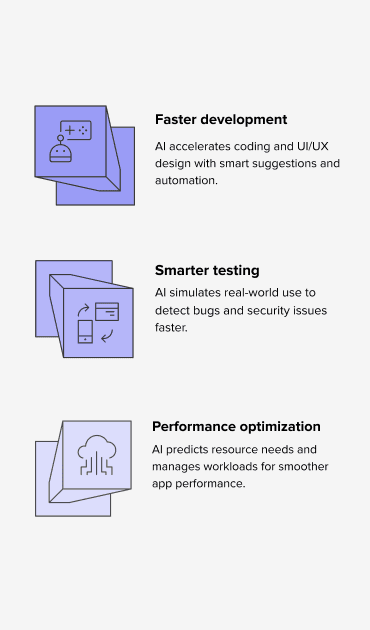
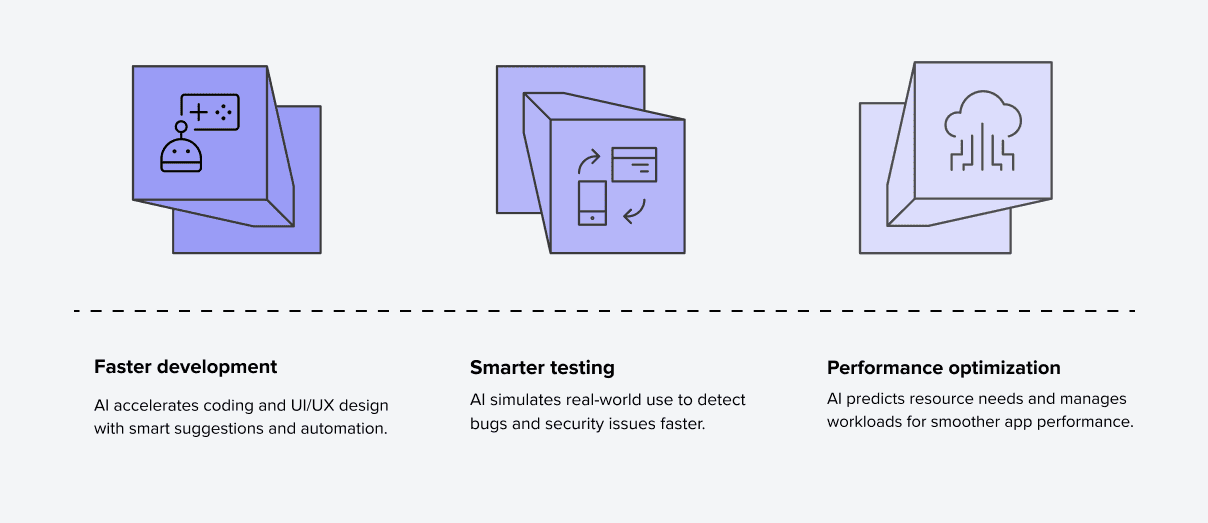
Streamlined development 

AI-powered tools like code generators and design platforms accelerate prototyping and development. Tools such as GitHub Copilot are capable of suggesting code snippets, while AI-driven UI/UX platforms optimize layouts based on user behavior trends.

Smarter testing

AI-driven testing simulators evaluate your app through different real-world scenarios to identify possible bugs, errors, and security vulnerabilities faster than traditional approaches. This reduces time-to-market and improves app reliability.

Enhanced performance

AI optimizes app performance by anticipating resource demands and efficiently managing background tasks. For example, AI can adjust server resources when there is excessive load on your app, making sure everything runs smoothly for everyone.  

How AI development partners can help you innovate with confidence

Integrating AI into mobile apps involves a structured process to ensure compatibility and performance. Partnering with an experienced Artificial Intelligence software development company can help you do the following:

  • Define objectives: Identify the AI features you want, such as chatbots, AI-powered recommendations, or image recognition, and align them with user needs.
  • AI tool selection: Select frameworks like TensorFlow, PyTorch, or Core ML for model development. For rapid integration, consider APIs like Google Cloud AI or AWS AI.
  • Design modular architecture: Use microservices to separate AI components from core app logic, ensuring flexibility and scalability.
  • Leverage edge computing: Deploy lightweight models on devices to reduce latency and bandwidth usage, especially for real-time features.
  • Testing: Simulate different scenarios to ensure AI features work across devices, networks, and user profiles.
  • Monitor and update: Use analytics to track AI performance and refine models based on user feedback.

Integration requires collaboration between developers, data scientists, and designers to create cohesive, AI-driven apps. All this can be overwhelming to take on if you don’t have the right expertise. Rather than hiring teams from scratch, many businesses choose to Hire AI Developers from 10Pearls, specialists in ML, computer vision, NLP, and mobile AI frameworks who can work alongside your existing team to accelerate integration, reduce risk, and deliver smarter, more performant mobile experiences.

Why choose 10Pearls for your AI mobile app development 

10Pearls stays at the forefront of what’s possible in mobile app architecture, integrating AI consulting services helps companies built core architecture to create apps that are not only intelligent but also highly scalable and adaptive to evolving user needs.

We offer end-to-end AI integration and work closely with decision makers to ensure AI strategies align with business goals. Hire artificial intelligence developers that help you develop AI-powered mobile apps, optimized, and more engaging, we empower businesses to deliver mobile solutions that stand out against their current landscape.

Exelon Recognizes 10Pearls for Advancing Inclusivity in Business Practices
10p-logo-get-in-touch

Get in touch with us

Global digital transformation and product engineering partner

Related articles

Top AI-Powered Software Testing Companies

AI/ML


Top AI-Powered Software Testing Companies

Compare the top AI-powered software testing services and learn how automation, self-healing tests, and AI-augmented QA de-risk enterprise releases.
Corporate AI Implementation Failure – Role of Leadership

AI/ML


Corporate AI Implementation Failure – Role of Leadership

Most enterprises now share the same models and tools, so why does AI still fail? The gap is leadership: prioritization, ownership, and governance, not better technology.

In-House vs Outsource Mobile App Development: What’s Best?

Mobile app development


In-House vs Outsource Mobile App Development: What’s Best?

Every mobile app starts with one decision: build in-house or outsource. We break down the real costs, tradeoffs, and the questions that determine which model is right for you.

Outcome Based Pricing in Digital Engineering

AI/ML


Outcome Based Pricing in Digital Engineering

AI is making outcome-based pricing more viable, but success still depends on clear metrics, shared accountability, and disciplined execution.

The Hidden Risk Behind AI-Powered Software Development

AI/ML


The Hidden Risk Behind AI-Powered Software Development

AI coding tools are accelerating development, but code review, governance, and quality assurance aren't keeping pace. Learn how enterprises can scale AI development responsibly.

Top 10 custom software development companies delivering innovative solutions

Software development


Top 10 custom software development companies delivering innovative solutions

This article compares the top 10 custom software development companies for 2025. The rankings are based on the average review rating on Clutch

Software Development Challenges and Solutions for Modern Enterprises

Software development


Software Development Challenges and Solutions for Modern Enterprises

Discover the top software development challenges enterprises face, legacy systems, security, talent shortages, and proven solutions to overcome them.

How AI is transforming Agile in 2026

Software development


How AI is transforming Agile in 2026

Modern Agile evolves with AI, cloud, and governance, reshaping team workflows and delivery for scalable, secure enterprise software in 2026.

Explore the tech driving software development innovation

Software development


Explore the tech driving software development innovation

Our top software development technologies in 2026 overview covers AI tools, low code & cloud development tools, programming languages, and databases.

Top sectors using custom software in Saudi Arabia

Software development


Top sectors using custom software in Saudi Arabia

Saudi Arabia is quickly shifting away from an oil-based economy for the first time in approximately 8 decades. As Saudi Arabia diversifies, the need for adaptable, sector-specific digital solutions is driving a rise in custom...

Privacy Overview
10Pearls Logo

This website uses cookies so that we can provide you with the best user experience possible. Cookie information is stored in your browser and performs functions such as recognising you when you return to our website and helping our team to understand which sections of the website you find most interesting and useful.

Strictly necessary cookies

Strictly necessary cookies should be enabled at all times so that we can save your preferences for cookie settings.

Third-party cookies

This website uses third party tools such as Google Analytics to collect anonymous information such as the number of visitors to the site, and the most popular pages.

Keeping this cookie enabled helps us to improve our website.