How Generative AI Accelerates Product Delivery & Time-to-Market

10p-circle-logo

By 10Pearls editorial team

A global team of technologists, strategists, and creatives dedicated to delivering the forefront of innovation. Stay informed with our latest updates and trends in artificial intelligence, advanced technology, healthcare, fintech, and beyond. Discover insightful perspectives that shape the future of industries worldwide.

Delays and bottlenecks can stem from many places throughout product development, from unclear and inconsistent expectations to inefficient task management. As an AI Consulting Services, Our experience shows that custom AI solutions, including generative AI for product development, can dramatically speed up product delivery and improve time-to-market.

Generative AI introduces capabilities that significantly increase the overall efficiency of traditional product development and delivery workflows. In this blog, we’ll begin by covering common bottlenecks that delay product delivery, how the use of generative AI can address them, and some of the most common misconceptions surrounding generative AI in product development. 

Traditional bottlenecks that slow product delivery 


Prolonged ideation
Turning an idea into a viable product plan is inherently time-intensive, especially if stakeholders aren’t aligned or operating within silos.

Planning
misalignment

Unclear objectives, ambiguous business alignment, and uneven input from stakeholders slow down the planning process.

Manual wireframing
Translating a plan into a product wireframe, evaluating features, user flows, technical constraints, and setting acceptance criteria are comprehensive tasks that take designers a significant amount of time.

Repetitive coding tasks
Actual coding and code management are critical product development stages, but the amount of redundant and repetitive coding tasks can significantly prolong time-to-market.

Slow QA cycles
Manually planning tests, writing test scripts, identifying edge cases by coordinating with domain experts, and root-cause analysis of bugs and failures are all time-intensive.

Deployment and documentation
Configuration of CI/CD pipelines, compliance and security integration, manually handling rollbacks, or automating these tasks using conventional tools are also time-consuming.

Key generative AI capabilities driving transformation for enterprises 

There are three core generative AI capabilities that enable it to accelerate the software delivery process: 

Expansive knowledge base

The deep and diverse knowledge base of genAI, acquired through training on billions of data points, is accurate enough to emulate domain and industry experts to a reasonable extent, offering insights and filling knowledge gaps.

Pattern recognition

This enables genAI to help product leaders solve problems, generate ideas, and streamline processes by identifying and matching the patterns common in current requirements with its existing knowledge base.   

Real-time data processing

GenAI tools can ingest and comprehend data in real-time, allowing them to keep pace with changing requirements and project scope, as long as they are prompted the right way and information doesn’t exceed their context awareness limit. 

How generative AI accelerates product development 

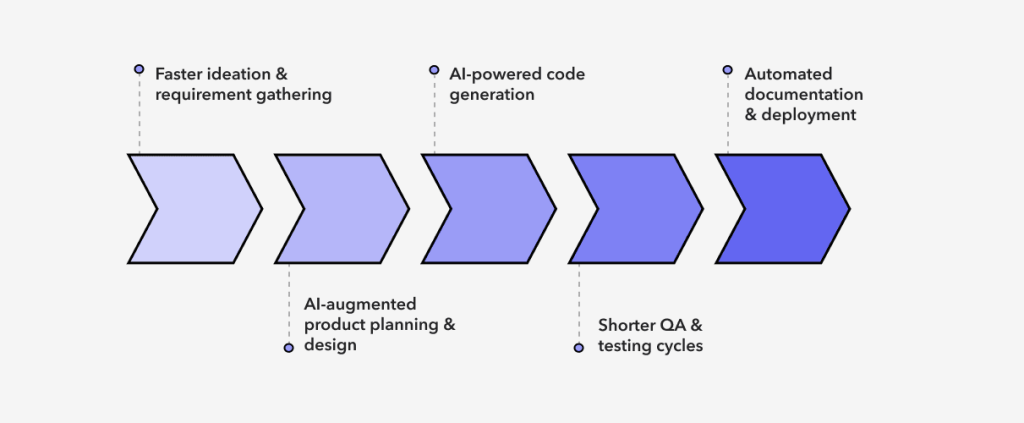
1. Faster ideation & requirement gathering  ​

A massive knowledge base allows generative AIs to contribute ideas, validate feasibility, and support idea mapping. It can also help stakeholders identify potential development challenges, costs, and timelines. 

At the information gathering stage, AI helps product leaders and stakeholders see the big picture by consolidating and processing information from various sources. It generates data-rich and dynamic user personas that draw from its knowledge of numerous similar projects.  

AI agents can gather information directly from users and stakeholders, significantly scaling the discovery phase since they can handle several interactions at once.  

2. AI-augmented product planning & design 

Using generative AI in product development accelerates several stages of design planning, including the alignment of business use cases with technical features, architectural choices like stack selection, and developing UX flows.

It helps product leaders pair technical features with business use cases and suggest optimal tech stack based on technical, maintenance, scalability, and security requirements and resource constraints.

In wireframing and UI, generative AI supports faster iteration of designs and mockups. Quick generation of mockups helps set the right tone for visuals, brand alignment, and user interaction from the beginning.

3. AI-powered code generation  

GenAIs and fine-tuned coding assistants like GitHub Co-Pilot are inherently great at learning patterns and rules, making them effective for emulating something as structured as coding. When it comes to AI product development, this allows them to generate a substantial amount of viable code in a development cycle, significantly reducing manual coding. Their most significant limitation for now is the scale of their contextual awareness.

4. Shorter QA & testing cycles 

QA testing services have become a critical component in the development and deployment of generative AI solutions. Test case creation, test script generation, and development of comprehensive boilerplates are rapidly streamlining and accelerating the quality assurance processes. It also covers scenarios humans might miss, especially for unique, highly innovative digital products.

Generative AI can be used to automate test implementation, create or improve CI/CD pipelines, adapt CI/CD pipelines and testing frequency based on broadly defined rules, and create test hierarchies.

AI can also emulate the randomness of users, stress test a more comprehensive range of scenarios, and identify vulnerabilities through simultaneous testing and code reviews (especially after code changes). Also, AI augmented root cause analysis can be more thorough and nuanced, more accurate, and significantly faster than humans, due to its pattern recognition capabilities.

5. Automated documentation & deployment 

An overlooked benefit of generative AI in product development is its ability to streamline documentation processes across teams. GenAI excels at content-heavy tasks, including software documentation. If given access to the codebase and kept in the loop throughout the development cycle, they can develop comprehensive and nuanced documents because they can process large volumes of information, including comments.  

This includes product documents written for business stakeholders, technical documents for developers, design documents for UX/UI, testing/QA documents for both internal stakeholders and audit, and user manuals. 

Generative AI improves and accelerates software deployment by assisting with the automation of CI/CD pipelines through optimal pipeline structure suggestions and writing automation scripts.   

Did you know?

Generative AI can accelerate product development by 5% or more and enhance the productivity of product leaders by 40%.

Source:

If you need specialized AI engineering talent to execute your generative AI roadmap, you can also Hire AI Developers from 10Pearls — pre-vetted engineers who bring deep expertise in GenAI, LLMs, and AI-accelerated software delivery for faster, higher-quality product launches.

Benefits of using generative AI for product development and delivery 

Competitive edgeA faster time-to-market gives you an advantage over competitors. To sustain this edge, develop strong AI governance frameworks to ensure your team and processes stay aligned.
Reduced development costAn Artificial Intelligence software development company strategically identifying, developing, testing, and automating tasks that can be done using AI, leading to fewer resources being spent, without compromising quality.
Better product-market fitWith accelerated development workflows, development teams can go through more iterations in less time and achieve a more refined, mature, and user-aligned product, which facilitates broader adoption.

Common misconceptions around AI integration 

Even though generative AI tools have the ability to emulate domain experts and offer diverse perspectives, they are not a replacement for human insight. Some misconceptions and challenges to recognize are: 

AI is a silver bullet

It’s important to understand the limitations of genAI tools. These tools have the greatest impact when they are applied strategically and not just for the sake of integrating AI.  

AI replaces human expertise

AI is progressing at a powerful pace but can’t fully replace all human expertise in software development yet. It’s an effective automation and generation tool but can’t push low or mid-tier talent to the premium level.

Experience doesn't matter

Hire AI developers that benefits from the collective experience of engineers, domain experts, and stakeholders whose real-world project exposure develops instincts that AI systems cannot easily emulate.

AI retains full context

There are hard token and data limits to how much context an AI model retains. It falls on product leaders to start with this inevitability in mind to organize and structure product development using consistent tracking markers. 

AI is bias-free

While most generative AI tools have their own bias checks in place, they still require oversight, especially in strictly regulated industries like healthcare or finance.  

Integrating genAI the right way with 10Pearls 

While its transformative potential is undeniable, taking the wrong approach to leveraging generative AI for product development can complicate and delay delivery. Working with an experienced partner like 10Pearls can help integrate genAI effectively, minimizing adoption and integration risk while maximizing its positive impact on the software development cycle

We help you leverage generative AI capabilities to improve, scale, and accelerate the product development process and reduce the manual burden on your team. From identifying friction points to developing an actionable roadmap, we bring a personalized, tailored approach to all AI adoption initiatives, helping businesses align AI efforts with their specific business goals.  

Exelon Recognizes 10Pearls for Advancing Inclusivity in Business Practices
10p-logo-get-in-touch

Get in touch with us

Global digital transformation and product engineering partner

Related articles

Outcome Based Pricing in Digital Engineering

AI/ML


Outcome Based Pricing in Digital Engineering

AI is making outcome-based pricing more viable, but success still depends on clear metrics, shared accountability, and disciplined execution.

The Hidden Risk Behind AI-Powered Software Development

AI/ML


The Hidden Risk Behind AI-Powered Software Development

AI coding tools are accelerating development, but code review, governance, and quality assurance aren't keeping pace. Learn how enterprises can scale AI development responsibly.

Top 10 custom software development companies delivering innovative solutions

Software development


Top 10 custom software development companies delivering innovative solutions

This article compares the top 10 custom software development companies for 2025. The rankings are based on the average review rating on Clutch

Software Development Challenges and Solutions for Modern Enterprises

Software development


Software Development Challenges and Solutions for Modern Enterprises

Discover the top software development challenges enterprises face, legacy systems, security, talent shortages, and proven solutions to overcome them.

How AI is transforming Agile in 2026

Software development


How AI is transforming Agile in 2026

Modern Agile evolves with AI, cloud, and governance, reshaping team workflows and delivery for scalable, secure enterprise software in 2026.

Explore the tech driving software development innovation

Software development


Explore the tech driving software development innovation

Our top software development technologies in 2026 overview covers AI tools, low code & cloud development tools, programming languages, and databases.

Top sectors using custom software in Saudi Arabia

Software development


Top sectors using custom software in Saudi Arabia

Saudi Arabia is quickly shifting away from an oil-based economy for the first time in approximately 8 decades. As Saudi Arabia diversifies, the need for adaptable, sector-specific digital solutions is driving a rise in custom...

A comprehensive guide to software development security standards for developers

Software development


A comprehensive guide to software development security standards for developers

This blog highlights five important software development security standards, also covering tips and best practices for keeping your application secure.

Discover the top software development outsourcing trends to watch in 2025

Software development


Discover the top software development outsourcing trends to watch in 2025

Top Software Development Outsourcing Trends for 2026 By 10Pearls editorial team A global team of technologists, strategists, and creatives dedicated […]

Unlocking success: How nearshore teams boost speed, quality, and innovation

Software development


Unlocking success: How nearshore teams boost speed, quality, and innovation

Nearshore teams accelerate innovation with faster development, cost efficiency, and seamless collaboration. Discover why businesses choose nearshore outsourcing and why 10Pearls is the top choice for expert nearshore development.

Privacy Overview
10Pearls Logo

This website uses cookies so that we can provide you with the best user experience possible. Cookie information is stored in your browser and performs functions such as recognising you when you return to our website and helping our team to understand which sections of the website you find most interesting and useful.

Strictly necessary cookies

Strictly necessary cookies should be enabled at all times so that we can save your preferences for cookie settings.

Third-party cookies

This website uses third party tools such as Google Analytics to collect anonymous information such as the number of visitors to the site, and the most popular pages.

Keeping this cookie enabled helps us to improve our website.