

10p-circle-logo
By 10Pearls editorial team

A global team of technologists, strategists, and creatives dedicated to delivering the forefront of innovation. Stay informed with our latest updates and trends in advanced technology, healthcare, fintech, and beyond. Discover insightful perspectives that shape the future of industries worldwide.

Software Development Architecture Design:
Key Principles 

This blog will explore the foundational principles of creating effective, scalable, and maintainable software systems. It will discuss common software development architecture design patterns and highlight the best use cases for each. It will also consider factors such as developer experience, scalability, and data requirements to help you choose the best approach for your software development project. 

5 common software development architecture design patterns

Architectures Pros & cons Use cases
Layered Easy to develop and maintain, but is less scalable Good for basic projects and smaller teams
Microkernel
Flexible, secure, and adaptable, but has lower performance
Used for embedded or automotive systems where stability is critica
Microservices
Resilient, flexible, and scalable, but have increased complexity and data management challenges
Good when fault isolation is essential and quick deployment is important
Event-driven
Greater agility due to decoupled services and superior fault tolerance, but added complexity
Useful for user interfaces such as inventory systems where real-time data distribution is critical
Space-based
High-performance data access, scalable, and redundancy, but lower data consistency and increased cost
Good for data-intensive systems including real-time analytics, financial trading, and social media

Common software development architecture design patterns 

Software architecture is the highest-level framework, or skeleton, of a software system. The software’s purpose will determine which architecture design pattern is most appropriate for its development.

Even though no two software projects are alike, certain software engineering problems recur often enough that common architecture design patterns have emerged to help solve them. Five of the most common include:

Layered architecture 

A layered architecture, also known as a monolithic architecture, is the most widely used pattern because it results in code that is easy to develop and maintain. It organizes code into layers so that programs can be broken down into subtasks for each. The four most used layers are:

LayerDescription
Presentation layer The front-end user interface (UI) that handles user interactions with the application
Application layer
The main programs of the architecture where software developers spend most of their time
Business layer
The business logic that tells a system how to run the application
Persistence layer
The data access layer that allows manipulation of various aspects of the database
Database layer
Where the system stores data, indexes, and tables and performs search operations

A monolithic architecture is a single unified codebase where all the layers are tightly integrated. It’s the standard approach that even inexperienced developers know how to work with, making it a good fit for basic software projects and smaller teams. However, this option is much less scalable and flexible than the other architectures listed below.

Microkernel architecture 

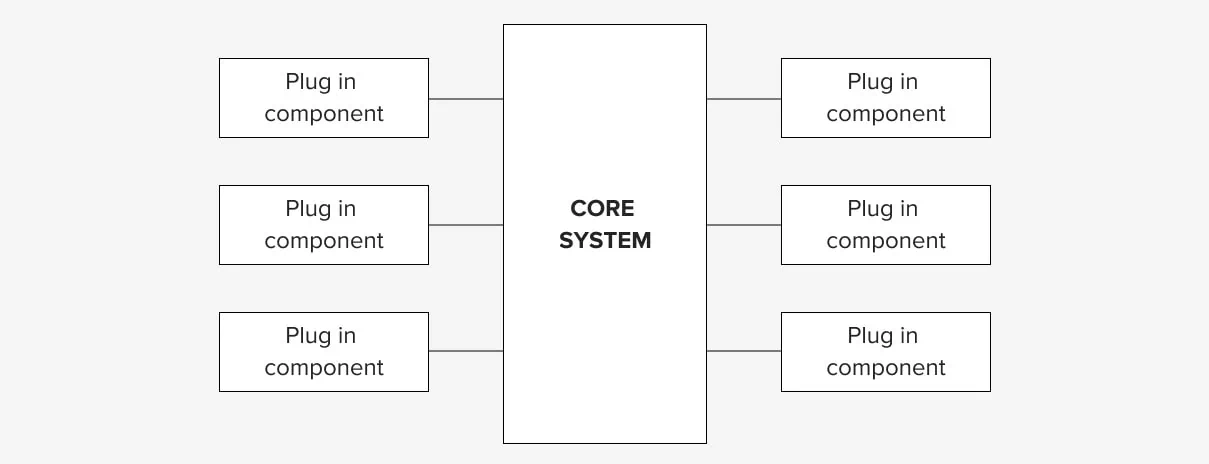
A microkernel architecture is highly flexible and adaptable. It separates applications into a minimal functional core and plug-ins with extended functionality. The core consists of standard business logic without any custom code, serving as a socket for an array of plug-ins containing specialized processing and custom features. Microkernel architectures work well for task scheduling and workflow apps, as well as software that is used for ingesting and transforming data.  

Microservices architecture 

A microservices architecture breaks software down into all the individual services (or microservices) that are required for functionality. Each microservice works independently of the others and can be shut down at will without affecting the rest of the application. Microservices applications are extremely flexible, resilient, and scalable, so this architecture choice is popular for cloud-native development. This architecture design provides fault tolerance because a failure in one service doesn’t crash the entire application, improving system reliability. It results in faster development and deployment, because teams can develop, test, and deploy services separately and simultaneously. Smaller, modular services are easier and more efficient to debug, update, and extend. 

Event-driven architecture 

An event-driven architecture is popular for applications with asynchronous data flow. It uses data-defined events to asynchronously trigger actions across distributed systems. Single-purpose event processing elements build a central unit, which accepts data and assigns it to modules that handle each specific type. Event-driven architectures are commonly used for user interfaces. 

Serverless architecture 

A serverless architecture involves decoupling the application layer from the underlying cloud infrastructure, so developers can build software while leaving the provisioning and maintenance of computing resources to the cloud service provider. Serverless architectures automatically scale up and down in response to demand and provide a great deal of flexibility. 

10Pearls has the expertise to help you choose the best software development architecture design for your project 

The software architecture is the foundation of your application, so it’s important to choose the right one for your individual needs. For example, a microservices architecture is very popular right now because of its flexibility, resilience, and scalability. However, it may not be suitable for small, inexperienced development teams that are used to more traditional architectures.

The best way to ensure you start with the best software development architecture design is to consult with expert engineers. For example, 10Pearls is a technology consulting firm with a large, global staff of software engineers who have experience with all the latest and most popular architecture patterns. Whether you just need a little help to get started or a partner to handle every stage of design and development, we’re ready to hit the ground running and deliver exceptional results. 

Get in touch today to learn more about our software architecture design expertise.  

10Pearls Logo

Get in touch with us

Global digital transformation and product engineering partner

Related articles

Top AI-Powered Software Testing Companies

AI/ML


Top AI-Powered Software Testing Companies

Compare the top AI-powered software testing services and learn how automation, self-healing tests, and AI-augmented QA de-risk enterprise releases.

Corporate AI Implementation Failure – Role of Leadership

AI/ML


Corporate AI Implementation Failure – Role of Leadership

Most enterprises now share the same models and tools, so why does AI still fail? The gap is leadership: prioritization, ownership, and governance, not better technology.

In-House vs Outsource Mobile App Development: What’s Best?

Mobile app development


In-House vs Outsource Mobile App Development: What’s Best?

Every mobile app starts with one decision: build in-house or outsource. We break down the real costs, tradeoffs, and the questions that determine which model is right for you.

Outcome Based Pricing in Digital Engineering

AI/ML


Outcome Based Pricing in Digital Engineering

AI is making outcome-based pricing more viable, but success still depends on clear metrics, shared accountability, and disciplined execution.

The Hidden Risk Behind AI-Powered Software Development

AI/ML


The Hidden Risk Behind AI-Powered Software Development

AI coding tools are accelerating development, but code review, governance, and quality assurance aren't keeping pace. Learn how enterprises can scale AI development responsibly.

Top 10 custom software development companies delivering innovative solutions

Software development


Top 10 custom software development companies delivering innovative solutions

This article compares the top 10 custom software development companies for 2025. The rankings are based on the average review rating on Clutch

Software Development Challenges and Solutions for Modern Enterprises

Software development


Software Development Challenges and Solutions for Modern Enterprises

Discover the top software development challenges enterprises face, legacy systems, security, talent shortages, and proven solutions to overcome them.

How AI is transforming Agile in 2026

Software development


How AI is transforming Agile in 2026

Modern Agile evolves with AI, cloud, and governance, reshaping team workflows and delivery for scalable, secure enterprise software in 2026.

Explore the tech driving software development innovation

Software development


Explore the tech driving software development innovation

Our top software development technologies in 2026 overview covers AI tools, low code & cloud development tools, programming languages, and databases.

Top sectors using custom software in Saudi Arabia

Software development


Top sectors using custom software in Saudi Arabia

Saudi Arabia is quickly shifting away from an oil-based economy for the first time in approximately 8 decades. As Saudi Arabia diversifies, the need for adaptable, sector-specific digital solutions is driving a rise in custom...

Privacy Overview
10Pearls Logo

This website uses cookies so that we can provide you with the best user experience possible. Cookie information is stored in your browser and performs functions such as recognising you when you return to our website and helping our team to understand which sections of the website you find most interesting and useful.

Strictly necessary cookies

Strictly necessary cookies should be enabled at all times so that we can save your preferences for cookie settings.

Third-party cookies

This website uses third party tools such as Google Analytics to collect anonymous information such as the number of visitors to the site, and the most popular pages.

Keeping this cookie enabled helps us to improve our website.