Integrate AI Into Your Business Processes: Best Practices for Success

10p-circle-logo
By 10Pearls editorial team

A global team of technologists, strategists, and creatives dedicated to delivering the forefront of innovation. Stay informed with our latest updates and trends in advanced technology, healthcare, fintech, and beyond. Discover insightful perspectives that shape the future of industries worldwide.

AI and machine learning technologies can solve many business problems as many exciting use cases across industries have shown. However, the integration process is often fraught with technical challenges and can leave companies with suboptimal solutions if not handled properly. This blog starts by identifying some of the business benefits of artificial intelligence, before providing tips and best practices to help you successfully integrate AI into your business processes.

Two professionals smiling while working together at laptop

Blog contents

Why integrate AI into your business processes?

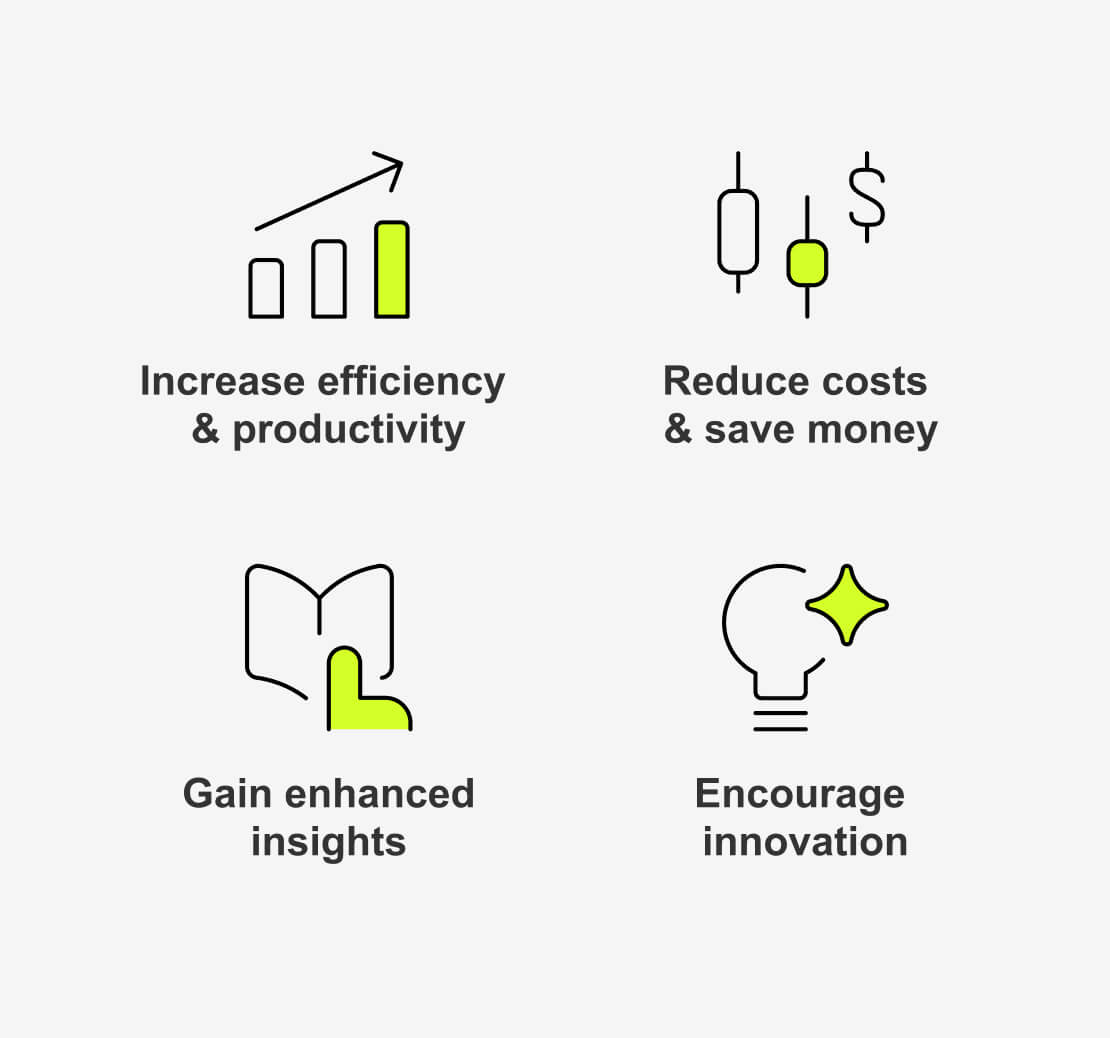
Adopting artificial intelligence and incorporating it into your business workflows can help you:

Advantages of integrating AI into business processes

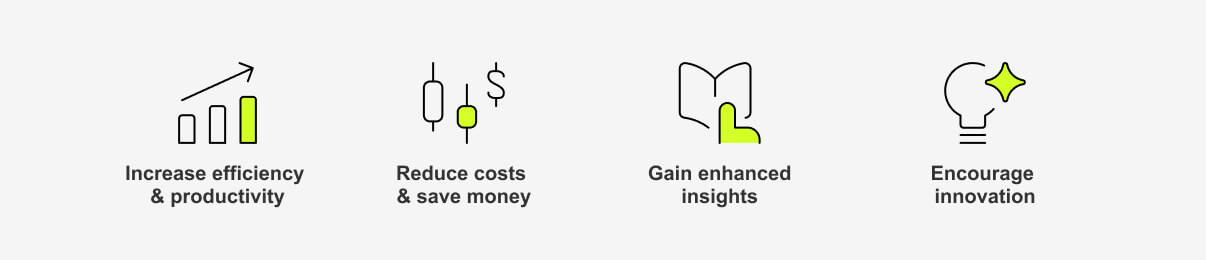
Increase efficiency and productivity

AI can help improve productivity throughout the business by automating repetitive, time-consuming tasks and performing them much faster. Examples include processing incoming job applications, triaging and assigning helpdesk incidents, and tracking equipment maintenance cycles. It takes this work off the shoulders of overburdened human employees and gives them more time to spend on complex and creative workflows that further drive efficiency and revenue.

Reduce costs and save money

AI can help reduce operational costs in several ways. It can analyze complex bills, like those from cloud service providers, and identify unnecessary expenses or wasted, unused resources. AI predictive maintenance tools can also help identify potential issues with automated machinery before they become expensive, line-stopping catastrophes. These cost savings can eventually offset the expense of adopting AI technology.

Gain enhanced insights

AI can analyze vast amounts of data from any source and generate meaningful, actionable insights organizations can use to improve their processes. For example, AI can help identify inefficiencies in manual or automated workflows that are impacting productivity. It can also uncover potential upsell opportunities in customer data to improve revenue.

Encourage innovation

Since AI helps automate some of the most frustrating and tedious tasks, it frees employees to get creative and come up with innovative new ideas for driving the business forward. AI’s ever-expanding list of capabilities also unlocks a wide-open field of potential use cases and products to help companies stand out from the competition.

Tips for a successful AI integration

Taking the following steps prior to adopting new AI technologies will help ensure a successful, streamlined integration.

Tips for integrating AI into business processes

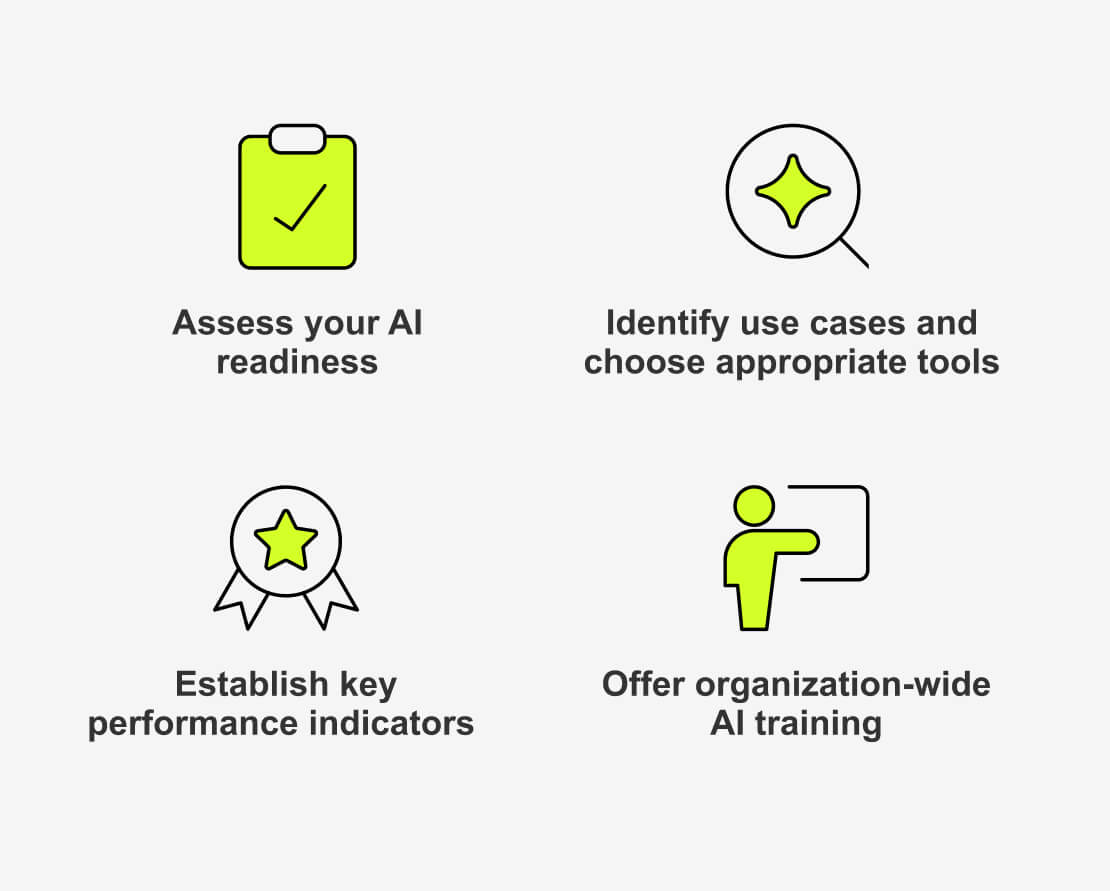
Assess your AI readiness

This step is crucial, but companies often overlook it in their rush to adopt exciting new AI technologies. An AI readiness assessment ensures that an organization has a solid foundation for new artificial intelligence integrations, reducing adoption headaches and allowing it to see faster value from its investment.

Key questions to ask as part of an AI readiness assessment include:

AI Readiness Assessment Questions

Category Questions
Business Alignment Does the business have:
  • An AI committee providing direction and oversight?
  • An actionable roadmap for integration?
Data Readiness Are there policies and tools in place to ensure:
  • Data governance?
  • Data bias prevention?
  • Smooth interoperability across systems?
AI Model Performance Basic mobile apps with limited functionality
  • How accurate are the AI models?
  • How will the team manage drift in production?
  • Is the model explainable to key stakeholders?
  • Is the model accurate and stable enough for your use case?
AI Infrastructure Does the team have an MLOps (machine learning for IT operations) framework to:
  • Manage model training?
  • Manage deployment?
  • Manage monitoring?
Security and Compliance
  • How does the organization ensure regulatory compliance?
  • Has adversarial testing been performed to harden against threats?
  • What measures are in place to uphold ethical AI principles?
Organizational Readiness
  • Does the team have the necessary AI/ML experience?
  • What training is needed and available across the organization?
  • How well are business teams aligning with AI teams for cross-functional collaboration?

Identify use cases and choose appropriate tools

The most successful AI implementations result from aligning specific business use cases with the right AI models and tools to solve those particular problems. One approach that can prove helpful is to start by playing with different AI solutions to discover what capabilities are available. Then, write a list of business problems and match them up with the tools that can solve them. These problems should be prioritized based on their overall impact on business processes and the organization’s ability to address them with the available AI tools.

For example, a major business problem that can be solved with an out-of-the-box AI solution, like an inability to accurately predict automated equipment maintenance schedules, should be prioritized above a less urgent issue that requires a custom-developed tool. Strategically prioritizing and aligning use cases with AI solutions will maximize the effectiveness and value of the resulting AI integration.

Offer organization-wide AI training

One benefit of conducting an AI readiness assessment is that it will help determine who in the organization needs training and what areas to focus on. This training should go beyond general awareness – teams need to understand the differences between generative AI and machine learning or statistical methods. This distinction is key to making informed decisions about what can be handled internally and what requires outside expertise. AI literacy training should be incorporated into regular IT and information security training for anyone expected to interact with artificial intelligence or machine learning systems. This training should include the team responsible for building, integrating, and maintaining AI tools, as well as the end users who are involved in the affected workflows. Robust AI training will help streamline the integration and adoption process.

Establish key performance indicators 

It’s important to determine the metrics by which you’ll measure the success of the AI integration. This process should be customized to the use cases established earlier, but some example key performance indicators (KPIs) include:

  • Error rate – The number of errors divided by the total number of task attempts
  • Task speed – How quickly tasks are completed compared to pre-AI
  • Cost savings – How much money is saved in labor, maintenance, etc.
  • Revenue growth – What revenue looks like compared to pre-AI
  • Employee productivity – How many tasks are employees completing each week with the assistance of AI
  • Support requests – How many end-user issues relating to the AI system are being fielded by the helpdesk team

Get world-
class support
for your AI integration

10Pearls is an AI-driven product engineering company with the expertise to help you successfully integrate AI into your business processes. Our AI/ML leads are seasoned strategists with deep expertise in advanced and emerging technologies, assessing your AI readiness to help you select the right tools and craft custom AI-first solutions that solve unique problems and support your company through the entire integration process. This combination of technical depth and business acumen enables our AI/ML leadership to guide complex, high-impact AI initiatives for enterprise clients.

Reach out for a free consultation to discuss your AI integration needs.

10pearls white logo

Empower your business with artificial intelligence

Cut through AI hype – future-proof your business with AI

10pearls white logo

Related articles

Top AI-Powered Software Testing Companies

AI/ML


Top AI-Powered Software Testing Companies

Compare the top AI-powered software testing services and learn how automation, self-healing tests, and AI-augmented QA de-risk enterprise releases.
Corporate AI Implementation Failure – Role of Leadership

AI/ML


Corporate AI Implementation Failure – Role of Leadership

Most enterprises now share the same models and tools, so why does AI still fail? The gap is leadership: prioritization, ownership, and governance, not better technology.

In-House vs Outsource Mobile App Development: What’s Best?

Mobile app development


In-House vs Outsource Mobile App Development: What’s Best?

Every mobile app starts with one decision: build in-house or outsource. We break down the real costs, tradeoffs, and the questions that determine which model is right for you.

Outcome Based Pricing in Digital Engineering

AI/ML


Outcome Based Pricing in Digital Engineering

AI is making outcome-based pricing more viable, but success still depends on clear metrics, shared accountability, and disciplined execution.

The Hidden Risk Behind AI-Powered Software Development

AI/ML


The Hidden Risk Behind AI-Powered Software Development

AI coding tools are accelerating development, but code review, governance, and quality assurance aren't keeping pace. Learn how enterprises can scale AI development responsibly.

Top 10 custom software development companies delivering innovative solutions

Software development


Top 10 custom software development companies delivering innovative solutions

This article compares the top 10 custom software development companies for 2025. The rankings are based on the average review rating on Clutch

Software Development Challenges and Solutions for Modern Enterprises

Software development


Software Development Challenges and Solutions for Modern Enterprises

Discover the top software development challenges enterprises face, legacy systems, security, talent shortages, and proven solutions to overcome them.

How AI is transforming Agile in 2026

Software development


How AI is transforming Agile in 2026

Modern Agile evolves with AI, cloud, and governance, reshaping team workflows and delivery for scalable, secure enterprise software in 2026.

Explore the tech driving software development innovation

Software development


Explore the tech driving software development innovation

Our top software development technologies in 2026 overview covers AI tools, low code & cloud development tools, programming languages, and databases.

Top sectors using custom software in Saudi Arabia

Software development


Top sectors using custom software in Saudi Arabia

Saudi Arabia is quickly shifting away from an oil-based economy for the first time in approximately 8 decades. As Saudi Arabia diversifies, the need for adaptable, sector-specific digital solutions is driving a rise in custom...

Privacy Overview
10Pearls Logo

This website uses cookies so that we can provide you with the best user experience possible. Cookie information is stored in your browser and performs functions such as recognising you when you return to our website and helping our team to understand which sections of the website you find most interesting and useful.

Strictly necessary cookies

Strictly necessary cookies should be enabled at all times so that we can save your preferences for cookie settings.

Third-party cookies

This website uses third party tools such as Google Analytics to collect anonymous information such as the number of visitors to the site, and the most popular pages.

Keeping this cookie enabled helps us to improve our website.