AI Data Readiness Roadmap & Guidance

10p-circle-logo

By 10Pearls editorial team

A global team of technologists, strategists, and creatives dedicated to delivering the forefront of innovation. Stay informed with our latest updates and trends in artificial intelligence, advanced technology, healthcare, fintech, and beyond. Discover insightful perspectives that shape the future of industries worldwide.

Data is the backbone of artificial intelligence (AI). An AI application’s efficacy and accuracy depend heavily on the quantity and quality of data fed to it. As such, special care must be taken to select and prepare AI-ready data. A lack of AI data readiness could have severe consequences, with Gartner® research from A Journey Guide to Delivering AI Success Through ‘AI-Ready’ Data predicting that “organizations that don’t enable and support their AI use cases through an AI-ready data practice will see over 60% of AI projects fail.”

The importance of AI data readiness can’t be overstated, but AI-ready data requirements differ significantly from traditional data management strategies, creating challenges for organizations. This blog provides a thorough overview of what AI data readiness means before offering a five-step roadmap to get your data AI-ready.

Professional team working together on AI data readiness roadmap, sitting around computer.

What is AI data readiness? 

There are three essential characteristics of AI-ready data: 

Alignment with business use cases

Meeting quality
requirements

Meeting governance
requirements

AI use case data alignment factors 

An Artificial Intelligence software development company help organization establish AI data readiness by clearly defining the data requirements for each AI use case. These requirements will likely evolve as data is used by AI applications in production. Some of the factors to consider while aligning data to specific AI use cases are listed below. 

AI use case data alignment factors

AI technology Different types of artificial intelligence technologies, like generative AI and computer vision, require differing types and quantities of data.
QuantityHow much data is needed will also vary depending on the use case, though any AI deployment requires a large volume of usable data.
Annotation and labeling                           Data needs to be properly annotated and labeled so the AI model knows how to identify the information contained within.
QualityIt’s crucial to ensure that data meets the specific quality standards for each use case, including identifying errors and outliers.
TrustThe various data sources must be reliable and diverse, with special care taken to avoid bias and other ethical concerns.
 

AI-ready data meets quality requirements

AI data should be continuously validated to ensure it meets quality requirements at all stages of training, development, and production usage. Below are some of the parameters for ensuring continuous quality. 

AI data quality parameters

Continuous validationData should be regularly tested to ensure it continues to meet quality requirements during AI development and usage.
Response timeIt’s critical to ensure that data performance adheres to service level agreements (SLA) for response time.
VersioningData changes and versions should be tracked and managed to mitigate drift and other data pipeline issues.
Regression testingData drift and failures should also be mitigated with continuous regression testing using custom test cases.
ObservabilityMetrics should be established to monitor and ensure data health, performance, and accuracy.
 

AI-ready data meets governance requirements

An organization’s AI data readiness is evidenced by its AI-specific governance policies, practices, and technologies. Here are some of the data governance requirements for AI-ready data. 

AI data governance requirements

Data stewardship            Consistent policies should be applied throughout the entire data lifecycle, with roles and responsibilities clearly defined.
ComplianceAI data must comply with regulations for privacy and security, including new, AI-specific laws like the AI EU Act.
EthicsSpecial care must be taken to ensure the transparency of AI data usage and mitigate ethical issues like training with real customer data.
FairnessIt’s important to proactively mitigate data bias and routinely test models to ensure fair decisions.
SharingTo support new and changing AI use cases, data architectures should enable safe sharing among various AI tools.
 

5-Steps AI data readiness roadmap 

There are five essential steps organizations can take to establish AI data readiness. 

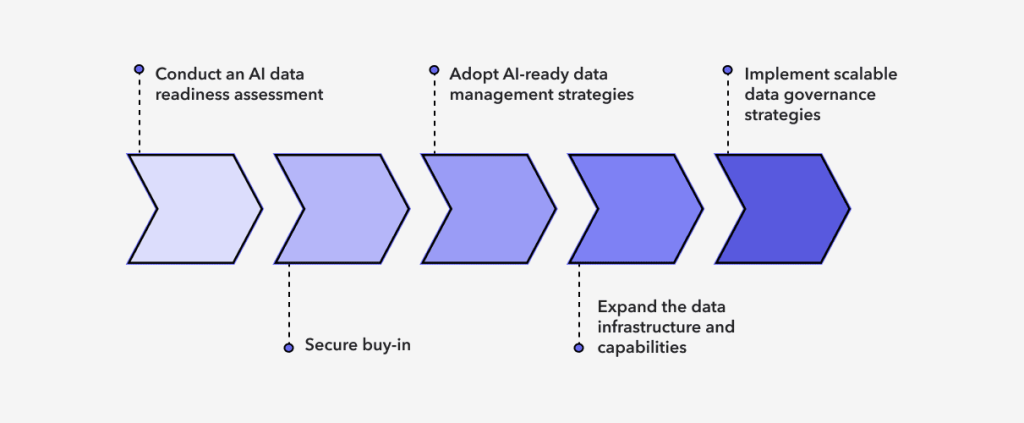
Flow chart graphic demonstrating the 5 steps of an AI readiness roadmap

1. Conduct an AI data readiness assessment ​

The best way to start is by assessing your current data management practices to identify weaknesses and determine where to target your efforts. Organizations without sufficient AI experience to thoroughly evaluate AI data readiness should partner with an established firm like 10Pearls to perform this assessment and learn the next steps.

2. Secure executive buy-in

Restructuring your data practices and architecture to support AI requires a lot of major organizational changes, so it’s absolutely crucial that you shore up support from executives and other business leaders. The rest of the organization will follow their lead, making it easier to implement the necessary changes. An AI consulting firm like 10Pearls can help by creating customized, high-level executive reports that highlight the business benefits of implementing AI-ready data practices.

3. Adopt AI-ready data management strategies 

We discussed several AI-specific data management practices and strategies above. This step involves adopting new policies, tools, and practices, or modifying your existing strategies to meet the requirements of your AI use cases. This step can be the most complicated, so many organizations may find it beneficial to work with outside AI implementation experts like 10Pearls to ensure a smooth transition.

4. Expand the data infrastructure and capabilities

The underlying technical data infrastructure needs to support not just your current AI initiatives but also any new or evolving use cases that may arise. This step may involve refactoring on-premises storage architectures, migrating data to the cloud, or integrating new tools into data pipelines. Working with migration and modernization experts like 10Pearls can significantly reduce the challenges involved and help eliminate the chances of business disruption.

5. Implement scalable data governance strategies 

Your new data governance practices must be able to grow with your AI capabilities to ensure scalability without compromising quality, safety, or ethics. Anticipating your future needs can be challenging, especially without prior AI experience, which is why it’s recommended to consult with AI experts when developing your data governance strategy.

Maximize your AI data readiness

10Pearls has the proven expertise to help your organization adopt AI-ready data practices and implement safe, scalable AI data architectures. Reach out to schedule a risk-free consultation with our AI data readiness experts.

Exelon Recognizes 10Pearls for Advancing Inclusivity in Business Practices
10p-logo-get-in-touch

Get in touch with us

Global digital transformation and product engineering partner

Related articles

Top AI-Powered Software Testing Companies

AI/ML


Top AI-Powered Software Testing Companies

Compare the top AI-powered software testing services and learn how automation, self-healing tests, and AI-augmented QA de-risk enterprise releases.

Corporate AI Implementation Failure – Role of Leadership

AI/ML


Corporate AI Implementation Failure – Role of Leadership

Most enterprises now share the same models and tools, so why does AI still fail? The gap is leadership: prioritization, ownership, and governance, not better technology.

In-House vs Outsource Mobile App Development: What’s Best?

Mobile app development


In-House vs Outsource Mobile App Development: What’s Best?

Every mobile app starts with one decision: build in-house or outsource. We break down the real costs, tradeoffs, and the questions that determine which model is right for you.

Outcome Based Pricing in Digital Engineering

AI/ML


Outcome Based Pricing in Digital Engineering

AI is making outcome-based pricing more viable, but success still depends on clear metrics, shared accountability, and disciplined execution.

The Hidden Risk Behind AI-Powered Software Development

AI/ML


The Hidden Risk Behind AI-Powered Software Development

AI coding tools are accelerating development, but code review, governance, and quality assurance aren't keeping pace. Learn how enterprises can scale AI development responsibly.

Top 10 custom software development companies delivering innovative solutions

Software development


Top 10 custom software development companies delivering innovative solutions

This article compares the top 10 custom software development companies for 2025. The rankings are based on the average review rating on Clutch

Software Development Challenges and Solutions for Modern Enterprises

Software development


Software Development Challenges and Solutions for Modern Enterprises

Discover the top software development challenges enterprises face, legacy systems, security, talent shortages, and proven solutions to overcome them.

How AI is transforming Agile in 2026

Software development


How AI is transforming Agile in 2026

Modern Agile evolves with AI, cloud, and governance, reshaping team workflows and delivery for scalable, secure enterprise software in 2026.

Explore the tech driving software development innovation

Software development


Explore the tech driving software development innovation

Our top software development technologies in 2026 overview covers AI tools, low code & cloud development tools, programming languages, and databases.

Top sectors using custom software in Saudi Arabia

Software development


Top sectors using custom software in Saudi Arabia

Saudi Arabia is quickly shifting away from an oil-based economy for the first time in approximately 8 decades. As Saudi Arabia diversifies, the need for adaptable, sector-specific digital solutions is driving a rise in custom...

Privacy Overview
10Pearls Logo

This website uses cookies so that we can provide you with the best user experience possible. Cookie information is stored in your browser and performs functions such as recognising you when you return to our website and helping our team to understand which sections of the website you find most interesting and useful.

Strictly necessary cookies

Strictly necessary cookies should be enabled at all times so that we can save your preferences for cookie settings.

Third-party cookies

This website uses third party tools such as Google Analytics to collect anonymous information such as the number of visitors to the site, and the most popular pages.

Keeping this cookie enabled helps us to improve our website.