AI Readiness Assessment - How to Evaluate If Your Enterprise Is Ready for AI
- 10Pearls Editorial Team
- 13 min read
Summary
An AI readiness assessment helps organizations determine whether they are sufficiently prepared in terms of the strategy, data, technology, skills, governance, and culture needed to successfully adopt AI initiatives. This guide explains how to assess each area and build a practical roadmap for AI adoption.
Most enterprises are moving fast on AI. They are piloting tools, approving budgets, and announcing strategies, often without stopping to ask whether they are actually ready for it. The cost of skipping that question can be significant. Gartner predicts that throughout 2026, organizations will abandon 60% of their AI projects that are unsupported by AI-ready data. An AI readiness assessment exists because readiness is not a single yes-or-no question, such as whether the organization has the budget. It spans data, technology, people, strategy, and governance, and a gap in any one of these areas can stall an otherwise well-funded initiative.
In this blog, we will walk you through how to evaluate AI readiness across the dimensions that matter. We will also provide a self-assessment checklist you can complete in minutes and show you how to use the results to prioritize gaps and determine where to focus.
Gartner predicts that throughout 2026, organizations will abandon 60% of their AI projects that are unsupported by AI-ready data.
What is an AI readiness assessment?
An AI readiness assessment helps in determining your company’s preparedness to adopt and scale AI tools and applications. The assessment analyzes some key areas like data, technology infrastructure, talent capabilities, and governance. It also includes identification of potential gaps and developing a clear course toward advanced AI initiatives.
The assessment for AI readiness can identify capability gaps before an organization commits significant resources towards AI transformation services. If the organization has issues like poor data quality, disconnected systems, unclear ownership, outdated processes, and skill shortages, then they are flagged at the right time allowing them to be addressed before they become costly roadblocks or cause an AI initiative to stall or fail.
It provides the basis for developing an actionable roadmap since it provides clarity on which use cases to prioritize, what capabilities to build, what dependencies to address, and what to do first, next, and later.

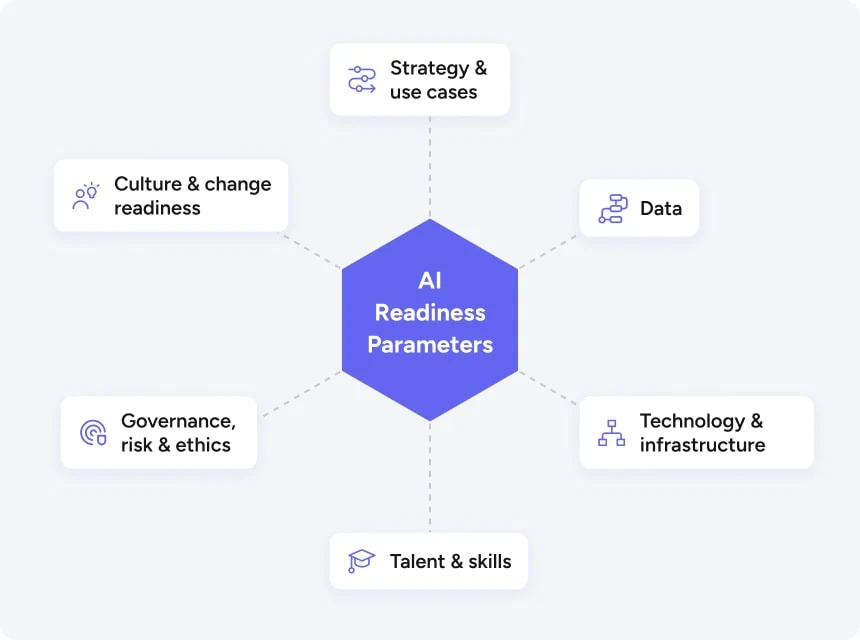
The dimensions of AI readiness
Strategy & use cases
Focuses on aligning AI adoption with broader business goals, identifying clear AI use cases, and prioritizing opportunities based on impact, feasibility, cost, effort, and risk.
Data
Assesses which data AI use cases require and whether the organization has reliable, relevant, accurate, well-structured data that can support AI applications.
Technology & infrastructure
Considers the infrastructure, cloud resources, data processing capabilities, software, and AI tools or models needed to implement, operate, and scale AI solutions.
Talent & skills
Examines the technical skills, AI experience, and expertise needed to implement AI, as well as resources and opportunities for employees to upskill and experiment with AI.
Governance, risk & ethics
Addresses the protocols and controls required for security, compliance, governance, risk management, ethical AI use, and keeping AI processes auditable and within acceptable boundaries.
Culture & change readiness
Evaluates whether the organization supports data-driven decision-making, continuous learning, experimentation, and the organizational change required to adopt AI, including clear communication from leadership about its impact on the business and workforce.
How to evaluate each dimension
Strategy
Can we identify our top three AI use cases and the business metric each is intended to influence?
Does each priority use case have an executive sponsor with the authority to allocate resources?
Have we estimated the potential ROI or cost savings before starting development?
Does each use case support an existing strategic priority?
What would be the business impact of choosing not to pursue these opportunities?
Data
Do we know where the data required for our priority use case is stored and who owns it?
Is the data consistent and reliable enough to support the intended application?
Can relevant people access the data efficiently?
Do we have enough historical data to train or fine-tune a model where required?
Technology & infrastructure
A strong position includes the technical capacity required for production use, as well as systems that can work together effectively, which is usually where ai integration services come in. It also involves having appropriate processes for deploying and monitoring AI models.
Do we have sufficient compute and cloud capacity for production use?
Can our AI tools integrate with the systems where the relevant work takes place, such as CRM, ERP, or ticketing platforms?
Do we have a process for deploying, monitoring, and retraining models?
Are our AI tools and technologies sufficiently standardized across teams?
Talent & skills
Do we have people who can build, evaluate, and maintain AI and machine learning systems?
Where are the most significant skills gaps?
Do we have a budget and plan for developing the skills of existing employees?
If additional expertise is required, do we have trusted partners or vendors that can provide it?
Governance, risk & ethics
A strong position requires clear policies and responsible AI practices, supported by appropriate security and risk controls of the kind ai governance services put in place. Organizations should also understand the regulatory requirements that apply to their planned use of AI.
Do we have a written policy that defines acceptable AI use?
Who is responsible for reviewing models for bias, accuracy, and potential unintended harm?
Are our planned AI applications compliant with relevant data privacy and industry-specific requirements?
Do we have security controls governing access to models, prompts, and outputs?
Can we audit or roll back a model if it produces problematic results?
Do we have a plan for incident response if a model fails, or a third-party AI tool is misused?
Culture & change readiness
A strong position is supported by visible leadership commitment, experience with organizational change, and employee confidence in new technologies. Adoption is more likely to succeed when people understand the role AI will play in their work and have the support needed to use it effectively.
Does leadership consistently communicate AI as an organizational priority?
What has our experience been with previous technology or process changes?
How do employees currently perceive AI and its potential impact on their roles?
Do we have a communication and training plan for employees who will use AI in their daily work?
The self-assessment scorecard
The six dimensions provide a structured AI readiness evaluation for organizations. This AI readiness assessment tool helps turn the evaluation into a practical score that shows where your organization stands today and which areas may need further attention.
How to score your AI readiness
Your AI readiness scorecard
| Dimension | Weight | 1 – Foundational | 3 – Ready | 5 – Advanced | Your score |
|---|---|---|---|---|---|
| Data foundations | 25% | Data is difficult to access or trust. Ownership, quality checks, and documentation are limited or missing. | Key data is accessible, ownership is defined, and quality checks are in place for priority use cases. | Critical data is well-documented, continuously monitored for quality, and accessible through reliable, controlled processes. | /5 |
| Strategy & leadership | 20% | AI priorities are unclear. Executive ownership, strategic direction, and dedicated resources are missing. | AI priorities and executive sponsorship are established, but funding, accountability, or alignment with business goals may be inconsistent. | AI priorities support business objectives, with accountable executive leadership, defined responsibilities, and committed resources. | /5 |
| Governance, risk & ethics | 20% | AI policies, ownership, and risk controls are absent or poorly defined. | AI policies and responsibilities are established, but risk reviews, security measures, or compliance checks are applied inconsistently. | Established policies, regular risk reviews, security controls, and audit processes support responsible AI use. | /5 |
| People, skills & culture | 15% | Teams lack the skills, training, or organizational support needed to adopt AI. | Some AI skills and training are available, but employee confidence and adoption vary across teams. | Teams have relevant skills, ongoing training, and organizational support, with AI adoption regularly measured and improved. | /5 |
| Technology & infrastructure | 10% | Existing systems and infrastructure limit AI experimentation, integration, or deployment. | Core AI tools and infrastructure are available, but integration, deployment, or monitoring capabilities need improvement. | Infrastructure supports reliable AI integration, deployment, and ongoing performance monitoring. | /5 |
| Use case & value | 10% | AI use cases lack defined business objectives, ownership, or success measures. | Priority use cases and expected business outcomes are identified, but value is not consistently measured. | AI use cases have defined baselines, measurable targets, and tracked results that guide future investment decisions. | /5 |
How to calculate your AI readiness score
Once you have rated all six dimensions, calculate your weighted score using the formula below. Multiply each dimension’s rating by its assigned weight, add the results, and multiply the total by 20 to get your overall AI readiness score out of 100.
AI readiness score calculation:
Weighted score = (Data foundations × 0.25) + (Strategy & leadership × 0.20) + (Governance, risk & ethics × 0.20) + (People, skills & culture × 0.15) + (Technology & infrastructure × 0.10) + (Use case & value × 0.10)
Final AI readiness score = Weighted score × 20Example: If your weighted score is 3.5, your overall AI readiness score is 70 out of 100.
How to read your result
Foundational
Significant capability gaps exist. Essential requirements across data, strategy, technology, and governance need attention.
Developing
Some foundational capabilities are in place, but gaps in resources, processes, or organizational readiness may limit progress.
Ready
Your organization has the core capabilities needed to pursue priority AI initiatives, with some areas requiring improvement.
Advanced
Your organization has established AI capabilities and processes that support broader adoption and scaling.
Turning results into an AI roadmap
An AI readiness assessment is a starting point for action. The goal is not to achieve perfect readiness across every dimension, but to understand where to focus first and how to sequence the next steps. The value of an AI transformation readiness assessment is in identifying the capabilities that need attention and using those insights to shape a practical AI strategy and roadmap.
Start by separating quick wins from foundational improvements. A quick win is a focused use case with a clear business outcome that can move forward with the capabilities already in place. A foundational improvement addresses a structural gap, such as strengthening data governance, developing critical skills, or establishing an AI usage policy. These improvements may take longer, but they can create the conditions for future AI initiatives.
Build your AI strategy & roadmap
Use the assessment results to create a practical AI strategy or roadmap that connects readiness gaps with specific actions and priorities.
Focus on the biggest gaps
Start with one focused pilot
Develop capabilities as you go
Scale when the organization is ready
Moving from individual pilots to broader adoption requires clear ownership, reliable data, appropriate infrastructure, and effective governance. Address these requirements before expanding AI across more teams or business processes.
Revisit your assessment regularly

Common AI readiness gaps
No prioritized use cases
Skills gaps
Technology investments do not automatically provide the expertise needed to use AI effectively. Assess the skills required for each initiative and combine tooling investments with upskilling, hiring, or external expertise where necessary.
Governance gaps
Establish clear ownership for compliance, security, model performance, and responsible AI practices, with processes to monitor and address issues after deployment.
Pilots that do not reach production
Successful proofs of concept can stall when there is no clear ownership for moving them into operational use. Assign responsibility for the transition from pilot to production and define the resources required to support the solution.
AI activity without a clear roadmap
Take the next step towards AI readiness
That is where 10Pearls can help. Our AI consulting services go beyond a checklist by evaluating your organization against industry peers, assessing data and infrastructure, and turning identified gaps into a prioritized, resourced roadmap. We help enterprises move from initial assessment to practical AI implementation.
Talk to our AI readiness team to turn your self-assessment into an actionable plan.
FAQs about AI readiness assessment
What is an AI readiness assessment?
What are the dimensions of AI readiness?
How do you assess your organization's AI readiness?
You can assess organizational AI readiness by reviewing each of the six dimensions against your current capabilities, processes, resources, and level of AI maturity. An AI readiness checklist can help structure the review, while an AI readiness assessment tool or scorecard can provide a consistent way to identify strengths and areas that need attention.
What does an AI-ready enterprise look like?
How long does an AI readiness assessment take?
What's the difference between AI readiness and data readiness?
AI data readiness focuses on whether the data needed for a specific use case is available and properly governed. It also considers factors such as data quantity, labeling, validation, trust, and ongoing monitoring.
AI readiness is broader. It also considers strategy, technology, talent, governance, and organizational culture, since successful AI adoption depends on more than the underlying data.
Related blogs
AI/ML
AI Readiness Assessment: A 6-Dimension Checklist
AI agents act with insider access at machine speed. Why that breaks traditional security models, and seven controls for engineering...

AI/ML
Securing AI Agents: 4 New Risks and 7 Controls
AI agents act with insider access at machine speed. Why that breaks traditional security models, and seven controls for engineering...
AI/ML
Why Corporate AI Implementation Fails
Why Corporate AI Implementation Fails & How to Fix It 10Pearls Editorial Team 13 min read Summary Corporate AI implementation...

AI/ML
How to Choose an AI Development Partner: Red Flags to Avoid
An AI project can impress in a demo and still fall apart on real data and real users. How to...
AI/ML
LLM in Healthcare: Use Cases, Risks & Deployment
A guide to LLM in healthcare, covering use cases, model selection, risks, HIPAA compliance, and what organizations need for deployment.
AI/ML
AI Governance Checklist: 9 Controls to Enforce
AI now writes a large share of production code, and it does not just change how software is built, it...

AI/ML
How AI Is Reshaping Healthcare Cybersecurity Threats
AI is helping both sides of healthcare cybersecurity. Attackers use it to speed up reconnaissance, write convincing phishing and deploy...

AI/ML
AI for Credit Unions: Use Cases, Agents and ROI
A practical guide to AI ROI at institutions under $1B, covering high-payback use cases, real integration costs, NCUA expectations, and...