What is AI-first architecture?
AI-first architecture (AFA) is a software development strategy where AI is at the core of the system’s design, instead of being treated as an add-on or secondary feature. This approach — embodied in custom AI/ML solutions, ensures that AI-driven capabilities such as automation, data-driven decision-making, and adaptive learning are foundational to the product from day one.. This approach is also described as AI-first software development, AI-first application development, or AI-first design.
Why it matters
AFA development represents a fundamental shift in how businesses design and develop AI-powered solutions. While AI is still in its early stages, companies across all industries have recognized its transformative value and are racing to embed it into their key products.
Without structured AI development services guiding the build, this approach can lead to systems with limited scalability, adaptability, and efficiency. AFAs overcome these challenges by ensuring that AI is deeply embedded from the start, allowing for faster data processing, model training, and more seamless automation.
How is AI-first architecture different from SOA?
Compared to software design strategies like service-oriented architecture (SOA), AFA differs by embedding AI-driven decision-making into the core of the system instead of using predefined rules and modular services for integration.
SOA focuses on creating greater interoperability and flexibility by structuring systems as a collection of modular services, allowing businesses to integrate diverse applications, streamline workflows, and execute system updates without having to overhaul the entire system.
Benefits of AI-first architecture development
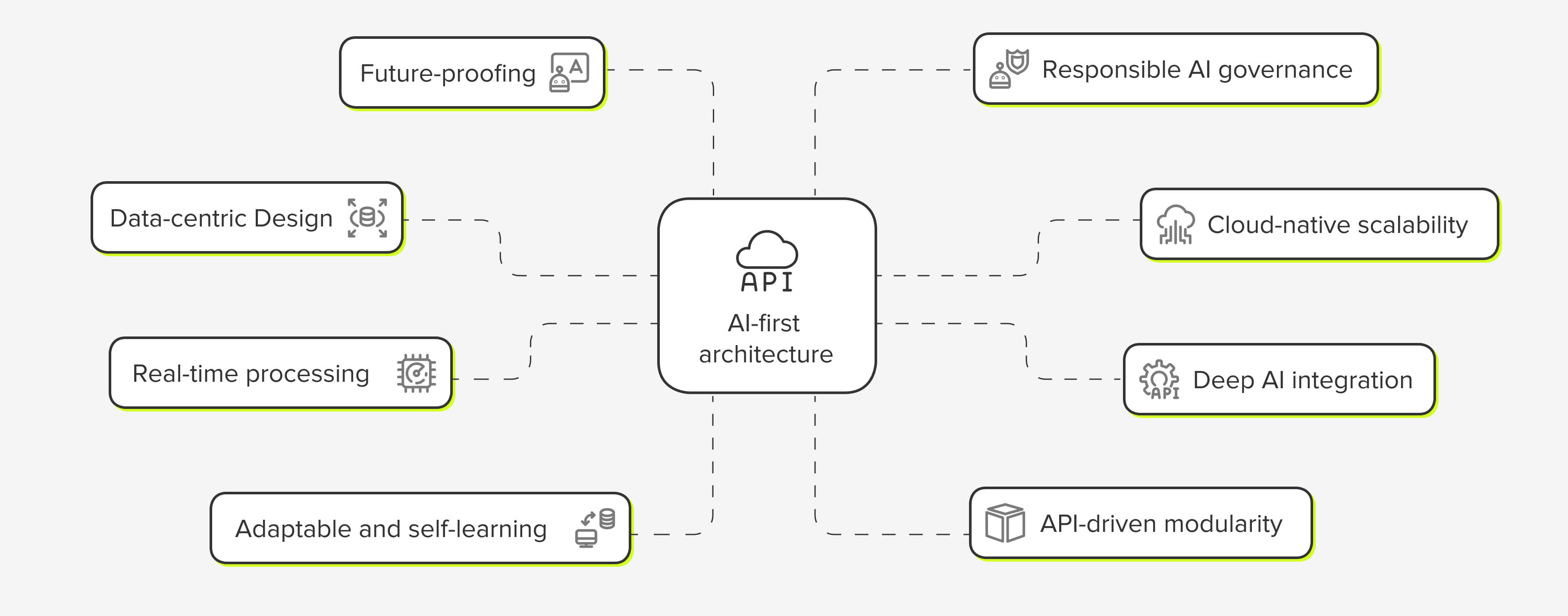
AFA is reimagining how systems process, learn, and evolve. They ensure AI-driven capabilities, such as natural language processing (NLP), computer vision, predictive analytics, and automation are not just bolted on but structurally embedded into the system’s core workflow. This approach brings several advantages for businesses looking to develop an AI solution.
Data-centric design
AI-first systems prioritize data collection, processing, and governance, ensuring machine learning models are continuously fueled with high-quality data. This structured approach allows for real-time analytics, predictive insights, and adaptive decision-making without manual intervention.
Cloud-native and scalable
AI-first platforms leverage cloud computing and distributed systems to enable seamless scalability, high availability, and optimized resource allocation. These systems dynamically adjust processing power, making them more efficient as they scale. Additionally, by supporting more efficient coding practices, AFAs can help reduce energy consumption by up to 50%.
Deep AI integration
Rather than being an external add-on, AI models are embedded directly into workflows, enabling:
- Automation of processes through AI-powered decision engines
- Personalization at scale, adapting to user behaviors in real-time
- Continuous learning and self-improvement, reducing the need for manual updates
Real-time processing
This is especially critical in fintech software development services, where real-time fraud detection and transaction decisioning require sub-second inference at massive scale.. This allows for immediate responses to changing conditions, improving efficiency and accuracy in mission-critical environments.
Adaptable and self-learning
AFAs incorporate machine learning pipelines that allow systems to self-optimize over time. Unlike traditional software that requires manual updates, AI-driven platforms can learn from new data, self-correct, and dynamically evolve in response to business needs and market shifts.
API-driven and modular
By exposing AI functionalities via APIs and microservices, supported by professional AI integration services, AI-first systems remain highly flexible and integrate with external applications effortlessly. This modularity ensures businesses can incorporate new AI advancements without disrupting core infrastructure.
Future-proofed against disruption
Organizations that embrace AFA today will be better positioned to integrate emerging AI technologies such as generative AI, autonomous agents, and self-optimizing workflows custom fintech solutions built on AI-first architecture are already leveraging autonomous agents for portfolio optimization and compliance monitoring. Without major system overhauls. This makes AI-first development a strategic investment for long-term innovation.
Responsible AI and governance for ethical AI deployment
AFA embeds fairness, transparency, explainability, and compliance into AI models, ensuring organizations meet regulatory and ethical standards while reducing risks associated with biased or opaque AI decision-making.
When to choose AI-first architecture for software development
Deciding on the right strategy for your software development project requires weighing critical factors like time, resources, team expertise, and budget. To help you understand, here’s a quick summary of how to know when each approach is the best fit.
Choose AFA when:
- Data-driven decision-making is a core need
- Scalability and adaptability are critical
- Competitive differentiation relies on performance of AI features
Choose SOA when:
- Integration and interoperability are critical
- Regulatory and compliance challenges exist
- Time and cost constraints are significant
- There are legacy system and integration complexities
In these cases, custom software development services can bridge the gap, modernizing legacy infrastructure incrementally while laying out the groundwork for a future AI-first migration. Ultimately, AFA is ideal for future-proofing and innovation, while SOA is better suited for stability, integration ease, and lower upfront investment.
Advantages of working with an AI partner
As AI adoption continues to grow, organizations must think strategically about their approach to AI integration. Whether it’s kickstarting an AI initiative, integrating AI into an existing system, or building an AI solution from scratch, engaging AI consulting services early in the process ensures architecture decisions are made with long-term scalability and business alignment in mind — not just immediate technical requirements. Without it, projects risk costly setbacks that stall progress or derail it altogether. Organizations that choose to build internal capability should focus on how to hire AI developers with deep architecture experience, not just model-building skills, to successfully lead an AI-first transformation.
Partnering with an experienced AI development team provides critical guidance and insight into managing key challenges and ensuring a smooth transition toward an AI-first system. Many enterprises are turning to software outsourcing services to access the specialized AI architecture talent needed for this transition — without the overhead of building that capability entirely in-house.