How to Measure ROI on AI Investments
- 10Pearls Editorial Team
- 7 min read
Summary
The AI initiative that generated so much excitement in the boardroom is now six months into deployment, a CFO, a skeptical board member, a new CEO looks up from the budget review and asks: “So what are we actually getting out of this?”
If you can’t answer that question with real numbers, you have a problem. Not necessarily because the AI isn’t delivering value, but because you haven’t built the infrastructure to see it clearly.
This guide is for leaders who want to change that. We’ll walk through what AI ROI actually means, the five components of meaningful investments, and a practical step-by-step process for measuring and communicating AI business value in terms that resonate with the people holding the purse strings.
What is AI ROI?
AI ROI is the measure of business value an organization gains from its AI investments relative to what those investments cost. It answers the question every executive and board eventually asks: are we getting more out of AI than we’re putting in, and by how much?
That sounds simple enough. But here’s where most organizations go wrong: they treat AI ROI as a cost-savings exercise. They calculate the hours saved, multiply by headcount cost, and call it a day. That’s not an AI ROI framework that’s an efficiency report.
Real AI ROI spans cost savings, yes, but also revenue growth, risk reduction, productivity gains, and strategic advantage. It weighs all of that against the full cost of building, running, and maintaining AI systems. Infrastructure, licensing, integration, retraining and the organizational costs of actually getting people to adopt and use these tools effectively.
One more thing worth saying upfront: measuring AI ROI is not a one-time calculation. It’s an ongoing discipline. You define value before deployment, track it through rollout, and report it continuously in language the business understands. Think of it less like a post-project audit and more like a management practice.

Why measuring AI ROI matters
Without a clear ROI measure, AI investments compete for budget on faith rather than evidence. And as we’ve all seen, faith doesn’t survive the first economic downturn or leadership change.
Gartner’s research has flagged a persistent problem: many AI investments lack a clear business case or defined ROI metrics, leading to overspending and stalled adoption that becomes very difficult to justify to CEOs, boards, and regulators. That’s not a technology problem. It’s a measurement problem.
According to a 2025 study by McKinsey, 64% of organizations say AI is enabling innovation, and most report use-case-level cost and revenue benefits. But only 39% can attribute measurable EBIT impact at the enterprise level. The gap isn't that AI isn't working - it's that organizations don't have the measurement frameworks to see the value they're already capturing.
A disciplined approach to measuring AI investment return lets leaders make real decisions: which AI initiatives to scale, which to fix, and which to retire. That’s a fundamentally different posture than hoping the technology pays off.

The building blocks of an AI ROI calculation
Before we get into the full framework, it helps to understand the four building blocks that any AI cost-benefit analysis needs to account for.
Returns are the quantified business benefits AI delivers: cost reduced, revenue added, risk avoided, time recaptured, and competitive position improved.
Costs are the full cost of AI ownership. This is broader than most people initially account for. Model development, infrastructure, integration, licensing, maintenance, and retraining are obvious. Change management and workforce training are frequently overlooked and just as real.
Time horizon matters because AI value typically grows after deployment as models improve and adoption deepens. ROI must be measured across a defined timeline rather than at a single snapshot in time.
Attribution is the method for isolating AI’s contribution from other factors. Without it, organizations either over-credit or under-credit AI for business results and both create problems down the line.
The 5 components of AI ROI
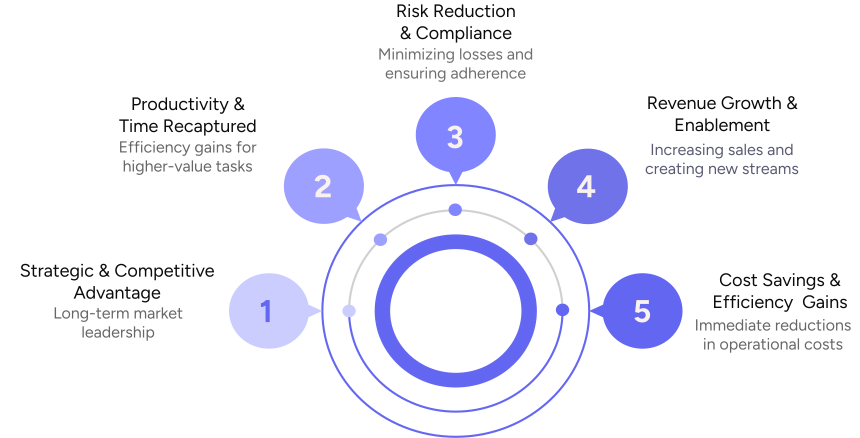
1. Cost savings & efficiency gains
This is where most organizations start, for good reason. It’s the most visible ROI metric and the easiest to quantify. The basic math is reduction in manual processing time across targeted workflows, expressed as hours saved per week multiplied by loaded cost per hour.
But there’s more to it. Error reduction rates that previously required expensive rework, remediation, or customer compensation are significant costs. Infrastructure, licensing, or operational costs avoided through AI-driven automation count too.
The trap with this component is that it’s so measurable that organizations over-rely on it. They hit a cost savings target, declare victory, and miss the fact that the larger AI business value is sitting in the other four categories. Cost savings is a floor, not a ceiling.
2. Revenue growth & enablement
AI-driven enhancements in sales, retention, or average transaction value are all quantifiable once you’ve set up the right tracking. This one requires a bit more analytical work, but it often leads to tangible business outcomes.
New revenue streams matter here too as AI capabilities like personalization, dynamic pricing, or entirely new AI-enabled products and services that didn’t exist before. These are harder to attribute, but they’re some of the most strategically important returns an enterprise AI investment can generate.
3. Risk reduction & compliance value
Often neglected in ROI conversations about AI, this component is one of the most important. Avoided losses are harder to notice than actual gains, so they often aren’t included in the ROI calculations as much as they should be. This is what reducing risk really means:
- fewer regulatory fines
- better audit outcomes
- reduction in compliance failures attributable to AI-assisted monitoring
- Fraud detection savings
- Credit risk improvements
- Cybersecurity threat detection with measurable breach-cost avoidance.
The way to quantify this component is to model the expected cost of the events AI helps prevent, weighted by their probability before and after AI deployment. If your fraud detection AI reduces fraud losses by 40%, you can calculate what that’s worth. If your compliance monitoring AI reduces audit findings, you can estimate the cost of the findings you’re no longer getting. This isn’t speculation – it’s actuarial thinking applied to AI.
4. Productivity & time recaptured
Hours per week recaptured from low-value, repetitive tasks matter most when those hours are genuinely redeployed to higher-value work. That’s an important distinction. Time saved that goes back into doing the same volume of work slightly faster has a different value profile than time redeployed to growth activities.
It’s also important to monitor how much time it takes to make decisions. AI helps speed up approvals, analysis, and responses, creating real benefits for businesses, even if it’s hard to measure those benefits in money. Quicker approvals lead to quicker agreements. Quick analysis leads to better decisions made at the right time. That adds up.
5. Strategic & competitive advantage
This is the hardest component to quantify and often the most valuable over a multi-year horizon. It’s also the one that justifies AI investment beyond pure efficiency plays.
McKinsey’s research found that a majority of organizations report AI has improved innovation, and nearly half report gains in customer satisfaction and competitive differentiation. Those aren’t soft, feel-good metrics. They’re indicators of market position.
Since it’s difficult to put a dollar value on this part, the best way to understand it is by using early signs: how quickly new products or features are released, how fast new ideas are being developed, and changes in market share for AI-related areas. These help you understand if AI is really creating a strong advantage, even if you can’t measure it exactly.

A step-by-step process for measuring AI ROI
Step 1: Establish a pre-AI baseline before deployment
This step is non-negotiable, and it’s the one that organizations most consistently skip because they’re eager to get the AI running. Before you deploy anything, document the current state metrics for every process AI will affect.
- What does a transaction cost today?
- What’s the error rate?
- How long does processing take?
- How many people are involved?
- Without this baseline, any ROI measurement you do later is guesswork dressed up as analysis.
The best way to explain this is: If AI will change how you handle invoices, you should know how much it costs to process each invoice, how long it usually takes, how many mistakes there are, and how many full-time employees are involved. Those numbers set your standard.
Step 2: Define quantifiable success metrics before launch
Once you have a baseline, set specific, measurable outcomes for each AI use case — before launch, not after. This is important because defining metrics after the fact creates unconscious bias toward metrics that make the initiative look good.
The key discipline here is aligning metrics to business KPIs, not technical performance indicators. Model accuracy is a technical metric. Reduction in invoice processing time from four days to same-day, at 80% lower cost, is a business metric. The CFO understands one of those. Make sure your metrics speak that language.
Step 3: Track both direct & indirect value streams
Build a value tracking dashboard that captures all five ROI components, not just the easy ones. This is where most measurement programs fall short — they’re rigorous about cost savings and silent about everything else.
Separate your metrics into two buckets. Quick-win metrics capture the value that shows up in months one through three: time saved, errors reduced, early adoption rates. Compounding value metrics capture what shows up in months six through twelve and beyond: revenue impact, risk reduction, competitive differentiation.
Track user adoption as a leading indicator of future ROI. It’s one of the most reliable predictors of whether an AI initiative will deliver its projected value. If adoption is lagging, the other metrics will follow. More on that in a moment.
Step 4: Account for total cost of AI ownership
Step 5: Report ROI in business language, not technical metrics
Model accuracy percentages mean nothing to a CFO or board member. Neither do F1 scores, precision-recall tradeoffs, or inference latency benchmarks. These are important for your technical team, but they’re not the language of ROI.
The discipline here is translating technical performance into business outcomes: dollars saved, revenue added, risk reduced, decisions accelerated. Every metric in your executive-facing ROI report should have a dollar sign or a business KPI attached to it.
Show the return on investment (ROI) with the timeline for the investment, so everyone can see how it grows over time. AI returns don’t increase steadily. At first, they grow slowly, but then they speed up as more people start using it and the technology gets better. If you only show a picture of one moment in the third month, the numbers will seem disappointing. Show the path.
Common mistakes that undermine AI ROI measurement
| Mistake | Why it undermines measurement | What to do instead |
|---|---|---|
| Measuring ROI too early in the deployment lifecycle | AI delivers compounding returns, not linear ones. Early readings look flat, sometimes disconcertingly so, and get treated as definitive evidence the initiative isn't working when the value curve simply hasn't started climbing. | Set checkpoints at 90 days, 6 months, and 12 months after launch. Share ongoing ROI progress with stakeholders rather than brief updates, showing where you sit on the curve and where the model projects you will be. |
| Focusing only on cost reduction and missing revenue impact | Cost reduction is the floor of AI ROI, not the ceiling. Organizations that measure only savings tend to avoid the most valuable use cases, because high-value opportunities in revenue growth, risk reduction, and competitive advantage don't fit an efficiency framework. | Track revenue-side value: growth, retention, and conversion. Measured seriously, it often exceeds cost savings by a significant margin. Don't leave it off the table because it's harder to quantify. |
| Ignoring adoption and training costs | An AI system nobody uses has zero ROI, regardless of technical sophistication or build cost. Adoption is the single biggest driver of AI ROI, yet gets the least attention in investment planning. If teams don't know how to use the tools or don't trust them enough to build them into real workflows, the investment evaporates. | Include adoption metrics and the cost of the enterprise AI training programs that drive adoption in every ROI report. A complete calculation includes the investment in people, not just technology. |
Putting it all together
To measure the return on investment (ROI) of AI, you need to set clear goals before choosing what to measure. You also have to keep track of all expenses, even the ones you don’t want to consider. Finally, you should provide updates over time, even if other people want quick results.
But the organizations getting this right aren’t just better at measuring AI. When you have a clear AI ROI framework in place, you make smarter bets. You scale what’s working, fix what isn’t, and retire what never will. You stop funding experiments on faith and start managing a portfolio of AI investments with the same rigor you’d apply to any other capital allocation.
That’s where the discipline of measuring AI ROI pays its biggest dividend. Not in the numbers themselves, but in the confidence to invest intelligently in what’s next.
Lean Product Accelerator™
Experience intelligent and rapid product development.
Related blogs

AI/ML
AI Agent Authorization: Governing Autonomous AI
As AI agents are granted more autonomy across enterprise systems, organizations need to define what agents can access and what...

AI/ML
Agentic AI Implementation: How to Build AI Agents
Turn agentic AI from an experimental concept into a production-ready capability with guidance on architecture, development, evaluation, deployment, observability, and...

AI/ML
Take agentic AI from promising idea to production-ready capability with a practical framework for building reliable agents, managing risk, and...

AI/ML
Agentic AI in the Telecom Industry
The telecom industry is embracing agentic AI for multiple operational and customer-facing use cases, while navigating legacy systems, integration, and...

AI/ML
Measuring AI Investments’ ROI | Framework for Enterprise Leaders
Learn how to measure AI ROI with a practical framework covering cost savings, revenue growth, risk reduction, productivity, strategic value,...

AI/ML
Developing an AI Policy | A Guide for Company Leadership
Learn how to create an AI policy for your company with an 8-step framework covering AI governance, risk, compliance, data...

AI/ML
How is AI being used in real estate in 2026
Discover how AI is transforming real estate, from asset management to contract intelligence, with practical use cases and signs that...

AI/ML
Building an AI Integration Strategy
Learn a practical 9-step AI integration framework to define outcomes, overcome organizational barriers, measure ROI, and build AI solutions that...
Get in touch with us
Global digital transformation and product engineering partner.