How to Create an AI Policy for Your Company: A Practical Guide for Leaders
- 10Pearls Editorial Team
- 7 min read
Summary
Companies are using AI without formal governance in place. This blog covers what an AI policy should include, how it differs from AI strategy, and an 8-step framework for building one that employees should follow for responsible AI adoption at scale.
Artificial intelligence is already at work inside most businesses in the tools employees use daily, in the vendor platforms quietly processing company data, and in decisions being made faster than any policy team can review them. The question is no longer whether AI is present in your organization. The question is whether anyone has defined the rules for how it gets used.
A corporate AI governance policy answers that question. It tells your workforce what is permitted, what is prohibited, and who is accountable when something goes wrong. This guide walks through what an effective AI policy actually covers, how to build one, and the mistakes that cause most early attempts to fail.
What is an AI policy?
An AI policy is a formal document that sets out the rules for how artificial intelligence tools and systems may be used within a business, by whom, for what purposes, with what data, and under what oversight.
In practical terms, it tells employees what they can and cannot do when using any AI-powered tool: from drafting emails with a generative AI assistant to using AI to analyze customer data or assist in hiring decisions. Without this document, those decisions are being made informally, inconsistently, and usually without any awareness of the risk involved.

AI policy vs. AI strategy vs. AI governance
| Aspect | AI Policy | AI Strategy | AI Governance |
|---|---|---|---|
| Primary purpose | Establish acceptable use and ethical boundaries | Maximize business value from AI investments | Ensure accountability, risk management, and regulatory compliance |
| Key question | What are we allowed to do with AI? | Why are we investing in AI, and where? | How do we ensure AI is managed responsibly? |
| Business focus | Responsible AI usage | Business transformation and innovation | Risk, compliance, and operational oversight |
| Scope | Employees, vendors, data handling, acceptable AI use | Enterprise AI initiatives, priorities, investments, and capabilities | AI lifecycle—from development and procurement to deployment and monitoring |
| Typical components | Acceptable use, privacy, security, intellectual property, human oversight, prohibited use cases | AI vision, business objectives, use-case prioritization, investment roadmap, capability building, ROI metrics | Roles and responsibilities, approval workflows, model inventory, risk assessments, audit trails, performance monitoring |
| Ownership | Legal, Compliance, Information Security, HR | Executive Leadership, CIO, CTO, Chief AI Officer, Business Leaders | AI Governance Committee, Risk Office, Compliance, IT, Data Governance teams |
| Time horizon | Relatively stable; updated as regulations evolve | Dynamic; reviewed annually or quarterly | Continuous throughout the AI lifecycle |
| Primary deliverables | AI policy document, employee guidelines, acceptable use standards | AI strategy, roadmap, investment plan, success metrics | Governance framework, control processes, review boards, reporting dashboards |
| Success metrics | Policy adoption, compliance rates, reduced misuse | Revenue growth, productivity gains, innovation, ROI | Regulatory compliance, reduced AI risk, audit readiness, model performance, accountability |
| Example | Employees must not upload confidential customer data into public GenAI tools without approval. | Deploy GenAI to reduce customer service costs by 30% and improve response times over three years. | Every AI model must undergo risk assessment, bias testing, security review, executive approval, and ongoing monitoring before production deployment. |
What an AI policy covers
A well-constructed AI policy for companies typically addresses five areas:
Employee use of approved and unapproved AI tools, including personal AI tools employees may be using for work tasks without organizational approval.
Data rules: What data can and cannot be put into AI systems, including private business information, customer details, and personal data that has rules about how it can be used.
Standards for AI-generated content: when human review is required before publication, when disclosure to external parties is necessary, and what quality standards apply.
Accountability structures: who is responsible for AI outcomes within the organization and how incidents, violations, or unexpected AI outputs are reported.
Vendor governance requirements: what standards third-party AI tools must meet before the organization can adopt them.

What to include in a practical AI policy usage template
The risk of operating without an AI policy
The most important thing to understand about AI policy for companies is that the absence of one is not a neutral position. Employees are already using AI tools – with or without organizational guidelines. Nearly 80% of organizations now use AI in at least one business function, yet most lack formal policies governing that use.
Without a standard AI policy, each employee has the freedom to create their own judgment about what data to share with an AI tool, what outputs to act on without review, and which vendor platforms are acceptable to use. That is not a workforce problem. It is a governance gap.
What an AI policy does & does not do
An AI usage policy template explains how AI can be used, who can use it, and what safety measures are needed. It is not a plan for technology, a guide for choosing suppliers, or a replacement for overall rules about AI. It includes how employees use AI, tools from vendors, content created by AI, and AI applications aimed at customers. Understanding this distinction matters because organizations sometimes try to solve governance problems through policy and policy problems through governance. The two layers need to be developed in parallel, not sequentially.
The core components of AI policy for companies
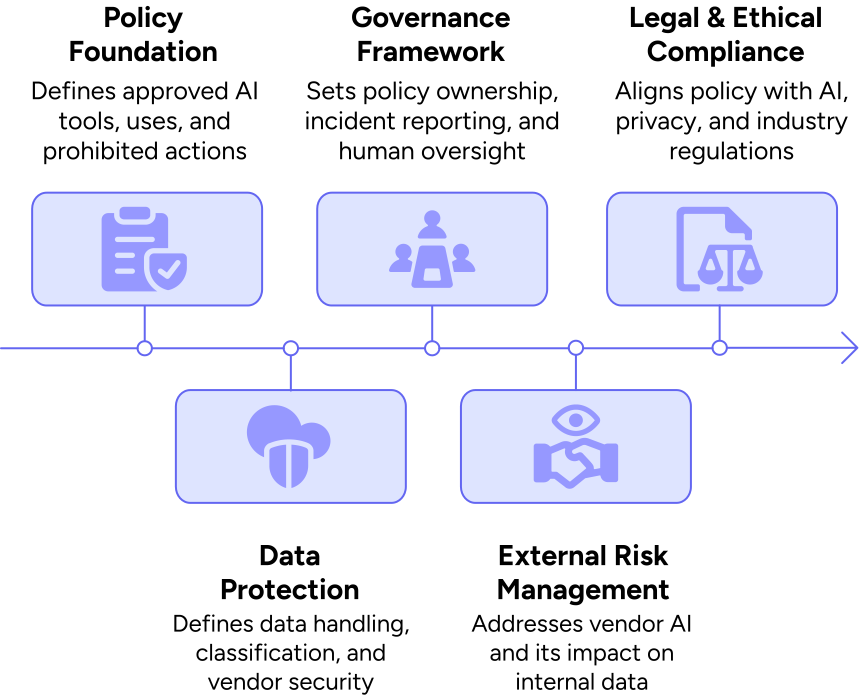
Acceptable use & prohibited uses
- Processing regulated personal data through unapproved AI tools
- Making autonomous decisions in hiring or credit contexts without human review
- Using AI to generate customer-facing communications without disclosure where legally required
Data privacy & security requirements
Data rules are the most consequential part of a responsible AI policy for companies. Most AI tools, particularly cloud-based generative AI products, process inputs on external servers. This means any data entered into those tools is leaving the organization’s controlled environment.
The policy should specify what data classifications are permitted in each category of AI tool, how confidential and proprietary information must be handled, and what contractual data residency and security standards AI vendors must meet before adoption. This section should be developed in coordination with existing data classification policies rather than written in isolation.
Accountability & oversight structures
This defines who owns the AI policy and is responsible for updates, how AI-related incidents and policy violations are reported and escalated, and what human oversight is required for high-stakes AI-assisted decisions.
Common roles include an AI Policy Owner (typically the CISO, General Counsel, or CDO), Business Unit AI Leads responsible for implementation within their functions, and a Compliance Review process for new AI tool adoption. The clearer these roles are defined, the less ambiguity employees face when a real situation arises.
Vendor & third-party AI governance
Many organizations focus their AI policy on internal employee behavior and overlook the risk surface created by the AI embedded in vendor platforms. If a CRM, HR system, or financial tool uses AI to make recommendations, that AI is operating within your organization’s data environment – and your policy needs to address it.
Compliance & regulatory alignment
The company’s AI rules need to match the laws that are relevant to them. For most companies, this means they need to follow GDPR and CCPA at the least. If you are doing business in or selling to the EU, the EU AI Act sets different rules depending on how risky the use of AI can be.
The NIST AI Risk Management Framework (AI RMF 1.0) provides a voluntary governance foundation applicable across sectors and serves as a useful structural reference regardless of geography. Sector-specific rules – HIPAA for healthcare, FCA guidance for financial services – sit on top of general AI regulation and must be addressed separately. The policy should also define how AI compliance will be audited and documented over time.
Step 1: Form a cross-functional AI policy team
AI policy development requires representation from Legal, Compliance, IT, HR, Finance, and at least one operational business unit already using AI. No single function has the full picture, and policies written without cross-functional input inevitably have blind spots that surface during implementation.
Designate a policy lead with authority to make binding decisions and resolve cross-functional disagreements. Importantly, make sure to include at least one worker who uses AI tools in their job. Policies made without asking those who do the work often create rules that people ignore because they don’t match how things are really done.
Step 2: Train leaders on AI before drafting starts
AI literacy must be established before writing policy, not after. Board members and top leaders need a basic understanding of how AI systems operate, what data they use, where mistakes and biases come from.
AI training workshops for business leaders help teams learn how to ask important questions and make smart decisions about policies. Without this basic understanding, policy drafts either end up with unclear guidelines that are hard to follow or very strict rules that prevent people from using things properly.
Step 3: Define scope & policy objectives
Establish a clear order of priority for primary objectives. Risk reduction, regulatory compliance, and innovation enablement are not always compatible, and the policy must reflect which takes precedence when they conflict. A well-scoped policy is more valuable than a comprehensive one: clear boundaries improve compliance rates and reduce ambiguity-driven violations.
Document explicitly what the policy does not cover so that edge cases can be handled through supplementary guidance rather than constant policy exceptions.
Step 4: Audit existing AI tool usage
Before writing any rules, document what AI tools are already in use across all functions – both officially approved and informally adopted. This audit is often the most surprising part of the process.
Shadow AI is more prevalent than most organizations realize. Gartner 2026 data shows 88% of employees with enterprise AI access also use personal AI tools for work tasks, creating data exposure that most organizations have not mapped. Catalogue AI usage by function, tool name, data types accessed, and category of decision influenced.
Step 5: Map legal & regulatory obligations
Identify all regulations that apply to the organization’s use of AI, including laws that vary by country for operations in multiple places. Specific rules for different industries are in addition to general AI regulations and need to be treated as separate requirements, not just included in general guidelines.
Following the legal compliance is the basic requirement for any good AI policy, but it’s not the highest standard. Business practices should go beyond just following basic rules when it’s beneficial to the company. Thinking of regulation as the highest limit often leads to rules that comply with the law but don’t accurately reflect the organization’s true risk level.
Step 6: Classify use cases by risk level
Assign every identified AI use case to a risk tier: low risk (informational), medium risk (operational), high risk (decision-influencing), and critical risk (autonomous). Riskier situations need more detailed rules, closer supervision, and clear requirements for human involvement. For each situation, write down the risks involved: possible bias, sensitivity of the data, accuracy needed, and what happens if the model fails.
Risk classification influences how we organize the rules for acceptable use and accountability. Policy rules should be adjusted based on the level of risk, instead of applying the same rules to every situation without considering the impact.
Step 7: Draft, pilot, & refine the policy
Write policy sections using simple and clear language that employees can easily understand and follow. It’s important to be accurate with the rules, but if the rules are hard to read, employees might not use them. Test the draft with a group of employees from various jobs and levels in the company before enforcing it.
For each rule, apply the enforceability test: can a line manager apply this rule in a real situation without seeking legal interpretation? If not, rewrite it. Treat pilot feedback as revision input, not a consultation exercise. Employees who contributed to shaping the policy are measurably more likely to comply with it after launch.
Step 8: Launch, communicate, and set review cadence
Launch requires dedicated internal communications, not a single all-staff email. Deliver policy content through role-appropriate channels: executive briefings, manager toolkits with scenario guidance, and accessible employee summaries without legal jargon.
Set up a way to report updates from the very first day. Workers should learn how to spot when AI is being misused and how to report unclear rules. Set up meetings every three months to check in on the policy and update it when there are major changes in AI technology, how the organization uses it, or legal requirements.

Common AI policy mistakes to avoid
Writing principles instead of rules
Policies built entirely on values statements - fairness, transparency, accountability - without specific behavioral rules are unenforceable. Every principle in the policy must be backed by at least one concrete rule specifying what employees should do, not just what the organization believes in. Vague guidelines can result in more legal complications than if there were no rules in place. They suggest they are in control but don't actually show it, which could mean that the organization was aware of the risks of AI and didn't deal with them properly.Treating it as a one-time legal exercise
AI policies drafted by Legal in isolation routinely fail to reflect operational reality and are quietly ignored within months of publication. Policy development must involve HR, IT, business unit leaders, and operational staff. When employees see a policy that does not match how they actually work, they stop reading it. AI is also developing faster than traditional policy review cycles. A policy with no built-in update mechanism is already becoming outdated from its first day of publication. Build review cadence in from the start.Setting rules without consequences
A policy that doesn't highlight clear consequences for breaking the rules is just a suggestion. Set proportionate consequences for different types of rule-breaking: accidental mistakes, careless policy violations, and intentional wrongdoings should each receive different responses from the organization. Ensure HR, Legal, and line management are aligned on how violations will be handled before the policy is published. Finding out mid-incident that there is no agreed process is exactly the situation a policy is supposed to prevent.AI policy templates & frameworks worth knowing
Several established frameworks provide useful structural foundations for AI policy development:
- NIST AI Risk Management Framework: a structured approach to identifying, measuring, and managing AI risk across the organization. Widely applicable across sectors.
- EU AI Act compliance requirements: relevant for any company operating in or selling into the European market. Introduces tiered obligations based on AI risk classification.
- ISO/IEC 42001: the emerging international standard for AI management systems, providing a certifiable framework for organizations seeking formal recognition of AI governance maturity.
- OECD AI Principles: a practical set of governance principles adopted across public and private sectors globally, useful as an ethical baseline.
What a practical AI policy template should include
Regardless of which framework you draw from, a working AI policy template needs to cover these elements at minimum:
- Purpose and scope statement: what the policy governs and who it applies to.
- Approved and prohibited AI tools: a maintained list, not a static document.
- Data classification and handling rules: what can go where.
- Roles and responsibilities: policy owner, department leads, and employee obligations.
- Incident reporting process: how to flag problems and who handles them.
- Review and update schedule: built into the document, not left to goodwill.
- Acknowledgement and training requirements: evidence that employees have read and understood the policy.
Turning your AI policy into a competitive advantage
Organizations with a well-defined strategy for implementing AI often experience benefits that extend beyond mere risk reduction. Employees use AI safely within set limits, boosting their work output without taking on more risk.
Leadership can report AI use and governance practices to boards and regulators with transparency rather than uncertainty.
Clients and partners place greater trust in organizations where responsible AI use is demonstrable, not assumed.
The policy itself becomes a foundation for scaling AI use cases, not a ceiling on innovation. Governance and ambition are not opposites – a well-designed policy enables more aggressive AI adoption, not less.
TABLE OF CONTENTS
The link between AI policy & AI maturity
Organizations that have a clear AI policy usually progress more quickly in using AI because their management and use of AI happen at the same time instead of one waiting for the other. Policies show investors, partners, and business clients that the organization is prepared in ways that just having technical skills doesn’t.
Combining a strong policy framework with enterprise AI training solutions creates the conditions for AI adoption that actually sticks at scale. Workforce enablement and governance are not separate work streams; they reinforce each other. When employees understand both what the policy requires and why it matters, compliance rates rise and the policy evolves through use rather than becoming a document that nobody reads.
Treat AI policy as a living document tied to a continuous workforce enablement strategy, and it becomes one of the more durable competitive advantages your organization can build in the current period of AI adoption.
Related blogs

AI/ML
LLM in Healthcare: Use Cases, Risks & Deployment
A guide to LLM in healthcare, covering use cases, model selection, risks, HIPAA compliance, and what organizations need for deployment.
AI/ML
AI Governance Checklist: 9 Controls to Enforce
AI now writes a large share of production code, and it does not just change how software is built, it...

AI/ML
How AI Is Reshaping Healthcare Cybersecurity Threats
AI is helping both sides of healthcare cybersecurity. Attackers use it to speed up reconnaissance, write convincing phishing and deploy...

AI/ML
AI for Credit Unions: Use Cases, Agents and ROI
A practical guide to AI ROI at institutions under $1B, covering high-payback use cases, real integration costs, NCUA expectations, and...
AI/ML
How Enterprises Can Scale AI Without Losing Accountability
AI now writes a large share of production code, and it does not just change how software is built, it...

AI/ML
Build vs Buy AI Talent: A CTO’s Guide
Hiring an AI team is only one way to build capability. This guide helps CTOs weigh the trade-offs between hiring,...
AI/ML
AML Transaction Monitoring and KYC: From Manual to AI
Traditional KYC and AML processes are struggling to keep up with modern financial crime. Learn how automation and AI are...

AI/ML
The AI Opportunity in Enterprise Data
Enterprises have more data than ever, but traditional predictive approaches may not be suitable to capture the context within it....
Get in touch with us
Global digital transformation and product engineering partner.