Beyond the API: Where AI Creates Value in Open Banking

By 10Pearls editorial team
A global team of technologists, strategists, and creatives dedicated to delivering the forefront of innovation. Stay informed with our latest updates and trends in artificial intelligence, advanced technology, healthcare, fintech, and beyond. Discover insightful perspectives that shape the future of industries worldwide.
Open banking
Open banking is one of the key components in KSA’s national fintech strategy, which itself is a core pillar of the Financial Sector Development Program (FSDP) under Saudi Vision 2030. However, fintechs in Saudi Arabia are rapidly realizing that getting access to open banking data, even as first movers, is not enough of a differentiator. How that data is leveraged will define success in the coming years.

Beyond connectivity: where AI creates the value
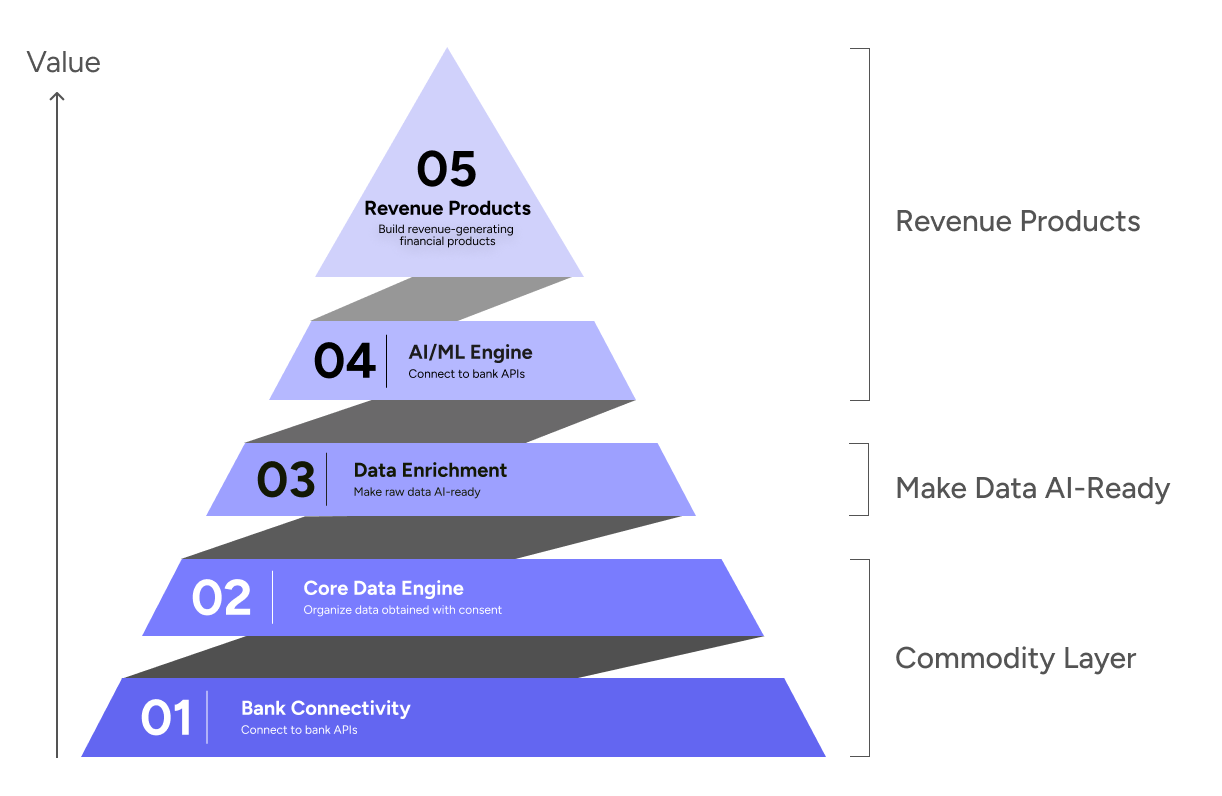
The open banking mandate requires participating banks to expose customer data through standardized APIs, whose specifications are outlined in the open banking Framework. From the perspective of the fintech accessing this data, the APIs form just the first layer of a five-layer stack that converts raw data into valuable financial products.
Let’s take a look at this stack.
Layer-1: Bank connectivity
Layer-1 is where a fintech licensed by SAMA – Saudi Central Bank (Previously, Saudi Arabian Monetary Authority) receive open banking data with customer consent, by connecting to banks’ APIs.
Key insight: Once the data is in the fintech environment, they become responsible for its protection as per Saudi Arabia’s Personal Data Protection Law (PDPL).
Layer-2: Core data engine
Layer-2 handles two critical aspects of open banking data: consent management (a key compliance requirement) and data organization, typically covering data ingestion, normalization, and categorization.
Key insight: At Layer-2, the data is useful for a range of conventional fintech products, but it’s not AI-ready yet. Even if AI tools are used for data normalization and categorization, it’s not counted towards the AI-driven value AI-augmented open banking can generate for a fintech.
Layer-3: Data enrichment
Layer-3 is the bridge between open banking connectivity and the AI-driven value that can be extracted from the data. Normalized data from Layer-2 is made AI-ready through cleaning, pre-processing, and transformation.
Key insights: Layer-3 is where commodity infrastructure starts to turn into a competitive advantage. Critical data decisions ensure optimal model outputs by improving the quality of the data it’s ingesting. Lineage and audit controls are embedded for improved data visibility and governance.
Layer-4: AI/ML engine
Relevant AI capabilities spanning from intelligent customer segmentation to decision intelligence, are applied to the enriched data at Layer-4 through AI integration services that connect models with the platform’s data, workflows, and controls. Critical model decisions are made in this layer too, like selecting models with built-in explainability where regulated products require decisions to be justified and audit ready.
Key insights: Tailored AI systems can be designed with the right mix of ML models, foundation models, guardrails, security controls, and custom logic, with NLP (Natural Language Processing) being used for context awareness across both Arabic and English data sources.
Layer-5: Revenue products
Layer-5 is where open banking connectivity and value-added AI meet market knowledge to build revenue-generating financial products.
Key insight: As open banking access becomes standardized, competitive advantage will come from what fintechs build on top of it. Hyper-personalization and granular segmentation let fintechs target smaller customer pools at higher conversion rates, opening niche markets traditional banks overlook.
AI-powered open banking use cases
Income verification without traditional documentation
Prove income from bank transactions alone, reducing dependencies on manual documentations and verification processes. By reading consented transaction history, this kind of product identifies and labels where a person’s money comes from: salary, government transfers, rent, freelance work, or investment returns.
The history is pulled and normalized in Layers-1 and 2, and enriched in Layer-3. Then models that are fine-tuned for Arabic and banking, identify and score income sources with confidence, stability, and reliability scores.
Lenders, landlords, BNPL providers, and insurers can use this to build products for large, underserved segments — significant in a market with a major expatriate workforce and a growing gig economy.
Transforming transaction data into meaningful financial information
Turn unstructured transaction data into clear, embedded financial insights. This kind of product converts raw transactions into clean categories, behavioral patterns, and forward-looking insights. This includes decoding cryptic entries like “POS 04382 RYD” into recognizable merchant names and categories, identifying spending and savings habits over time, and generating ready-to-use outputs such as monthly breakdowns, savings opportunities, and unusual-spending alerts.
A variety of financial services providers like banks, neobanks, wealth managers, and loyalty platforms can leverage these insights to power a B2B2C model, well-suited to the Saudi Arabia’s fast-accelerating digital-banking adoption, led by names like STC Bank and D360.
Assessing creditworthiness beyond credit bureaus
Score creditworthiness from how someone actually banks, not just their bureau history. This kind of product turns behavioral data into a risk assessment that responsibly underwrites the thin-file and unbanked customers traditional bureaus can’t reach.
Over 200 behavioral signals like income stability and expense volatility are leveraged to assess risk and affordability, updated almost in real time as new transactions arrive. Explainable ML models return a clear score, risk band, and the reasons behind it.
Banks, BNPL providers, and SME lenders can build on it. With a young population and fast-expanding SME sector, it’s one of the high-value product the stack enables in Saudi Arabia.
How it fits together: from raw data to revenue products

All three (and many more like these) use cases may be served by the same Layer-1 and Layer-2 and a largely shared Layer-3 — same architecture, different logic and controls. Even in Layer-4, the same foundation model can power the language understanding and much of the reasoning across all three. Architecturally, there are differences — batch versus real-time pipelines, for instance — but all three are still just implementations on one shared platform. This highlights the enormous potential of launching new financial products with the right AI-augmented Open banking foundation.
10Pearls: The right technology partner for AI-augmented open banking
A deep understanding of customer needs, market trends, and underserved segments is a strong starting point for fintechs. Even a general idea of a solution can be shaped into a revenue-generating product with the right technology partner.
As an AI software development company with over two decades of experience working with the financial industry, we possess a deep understanding of the regulatory landscape. We have supported fintech innovation at scale, and offer end-to-end AI development services, making us well-positioned to help financial institutions build and scale AI-powered open banking products.
Snapshot of our work in the financial sector
- Modern, AI-powered banking platforms: We design cloud-native, API-first banking platforms with ML-driven personalization. It’s an architectural pattern a multi-tenant Open banking platform requires. (Case study)
- Secure, real-time data integration: For an investment manager, we built a secure portal pulling live data from Oracle Fusion Cloud ERP, enabling adoption across 10,000 distributors. (Case study)
- Agentic AI for financial operations: Through our agentic AI development services, we built an agentic AI financial assistant using FinBERT with GPT-4, automating reconciliation and delivering personalized, data-driven financial insights. (Case study)
- Intelligent automation for financial decisions: For an equipment-financing provider, we used Salesforce and Einstein AI workflows to automate loan and claims processing to accelerate approval cycles and improve accuracy and compliance oversight. (Case study)
The way forward for fintechs
Fintechs in Saudi Arabia are already investing in the infrastructure to access open banking data through banks’ APIs and meet SAMA’s technical requirements. The pragmatic next step is to start building towards AI-driven open banking platforms capable of powering a wide range of revenue-generating financial products. As an AI-first partner with deep financial industry experience, 10Pearls can help you build the intelligence layers on top of the connectivity you’re already building, turning open banking into new revenue streams.