I’m often asked my opinion regarding the relative merits and fully-loaded cost of software development in various technology centers around the world. My response draws upon 15 years running a software development firm with teams on 3 continents and prior experience managing a $150 million outsourcing budget for a Fortune 100 Company. Here, summarized below, is what I usually say and I want to share it with you now. – Imran Aftab, CEO
Over two decades ago I founded 10Pearls which, has grown from nothing to a leading software development provider with over 1,350 employees and offices in the United States (DC, IL), Pakistan (Karachi, Lahore, Islamabad), Colombia (Medellin), United Kingdom (London), Saudi Arabia (Riyadh), San José (Costa Rica), and Lima (Peru). Prior to founding 10Pearls, I led the global outsourcing initiatives at companies like AOL-Time Warner and Sprint, managing $150 million budgets. Roughly 30% of that budget went to India and the rest was distributed across other markets. That individual experience, followed by many years of corporate experience as a provider of blended-shore product development, has resulted in a deep understanding of the industry and many helpful lessons about achieving the best value.
Here’s what you need to know:
- Cheaper is not better: In outsourcing, there is a difference between cost vs price. Real cost is tied to the productivity or value you get for your money. Cheap, Fast, Good…that is what Gartner recommends these days (they actually put up that slide at a conference). However, the more intangible components like “quality” are key (more on that shortly). It’s also important to consider what additional skill sets a development partner brings – technical know-how, cybersecurity practices, design, etc.
– - Productivity is key: The biggest and most nebulous issue in outsourcing is productivity. This is not just tied to hiring good tech talent but also, and most importantly, retaining them (churn puts the brakes on productivity). Yet, retention comes at a price and requires sincere commitment. Most development services providers, including the largest firms, do not take that into consideration, as evidenced by a lack of investing back in their employees, operations, processes, training, etc. Additionally, productivity is a measure of the number of “productive” hours a contributor is available for. It is important to take into consideration in-country holiday schedules, cultural norms, and work ethic, so productivity optimization doesn’t bring down morale. Productivity is something that can definitely be measured and improved in terms of development velocity.
– - Leverage outsourcing for knowledge: There is a trade-off in innovation, efficiency, and productivity between outsourced offshore vs. captive offshore (that you fully own and operate). The latter can be effective when you reach a certain size, but the former allows you to achieve the necessary critical mass, or “mindshare,” of a larger and more diverse pool of talent efficiently. Therefore, unless you can afford enough developers to justify your own “captive” shop, choosing the offshore partner is absolutely the most important decision you can make when it comes to the real cost per person (as mentioned in the previous point with respect to productivity).
– - Location, location, location: Optimizing between location and talent can be tricky. Unless you are spending more than $5 million per year, your dilemma is often: [Top tier location + Lower tier developers] versus [Lower tier location + Top tier developers].
–- Top Tier Locations: Factors that make a given location “top tier” include the availability of technology skills, population size, English language skills, political stability, currency arbitrage, IP protection laws, and ease of doing business, among other things. However, most top tier locations are saturated, so it’s hard to compete with big brands/businesses who are hiring there by the thousands. These locations are also producing great start-ups of their own. For example, Zoho from India and CD Projekt Red from Poland. India, Ukraine, Philippines, Mexico, and Poland are among the conventional top tier locations.
– - Lower Tier & Emerging Locations: New offshore development destinations are popping up everywhere in the world, thanks to improved educational standards and widespread internet connectivity. Some may be suitable, and some may not. For example:
–- Tunisia is coming up fast, but only for mostly French speaking clients.
– - Similarly, Eastern Europe (Romania, Baltics, Czech) has plethora of options, but only good if you need relatively small teams. These are smaller populations. Developers are also known to be interested in more R&D focused work, and currency arbitrage is minimal.
– - Colombia is rising fast and is taking spillover from Costa Rica (which is now saturated). However, cost and communication may be an issue.
– - Vietnam, Bulgaria and Pakistan are emerging. They all have their challenges and benefits. Vietnam has communication issues, but very cheap rates and the official focus is on semiconductors and hardware. Bulgaria is attracting some very big names but has scalability issues due to a small talent pool. Pakistan has political perception issues, but a massive pool of quality developers – and is currently the 3rd largest English speaking country in the world, courtesy of the Queen.
- Tunisia is coming up fast, but only for mostly French speaking clients.
- Top Tier Locations: Factors that make a given location “top tier” include the availability of technology skills, population size, English language skills, political stability, currency arbitrage, IP protection laws, and ease of doing business, among other things. However, most top tier locations are saturated, so it’s hard to compete with big brands/businesses who are hiring there by the thousands. These locations are also producing great start-ups of their own. For example, Zoho from India and CD Projekt Red from Poland. India, Ukraine, Philippines, Mexico, and Poland are among the conventional top tier locations.
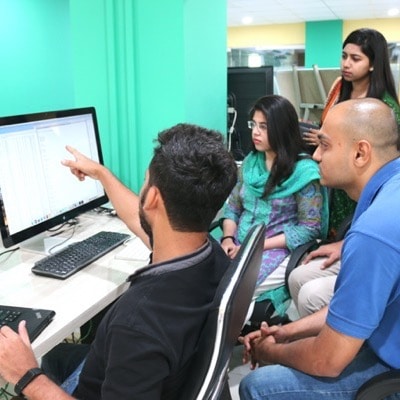
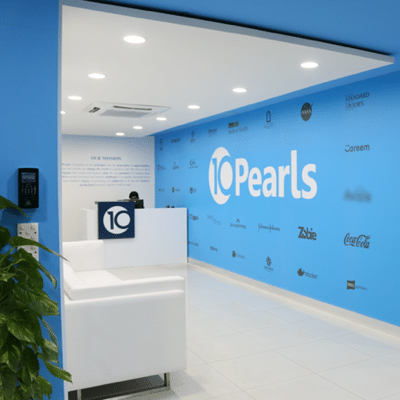
(A look inside the 10Pearls office in Karachi, Pakistan)