Banking as a Service (BaaS): How Non-Financial Platforms Build Embedded Financial Products
- 10Pearls Editorial Team
- 14 min read
Summary
Discover how Banking as a Service (BaaS) powers embedded financial experiences, what sets it apart from embedded finance, and how businesses integrate accounts, cards, payments, and lending into their platforms without becoming banks.
According to the Prudence, Profits, and Growth 2024 report, by 2030, the global embedded finance market is expected to exceed $320 billion in revenue, reflecting how quickly financial services are moving beyond traditional banks and into everyday digital experiences. As businesses look to embed accounts, payments, cards, and lending into their products, Banking as a Service (BaaS) has emerged as the infrastructure making this shift possible.
BaaS makes it easier for organizations to introduce financial products without building banking infrastructure from the ground up. Instead of developing and operating these capabilities themselves, they can work with licensed banking partners and fintech software development services teams, and focus on delivering better customer experiences.
That is the role of Banking as a Service (BaaS). BaaS allows licensed financial institutions to expose banking capabilities through APIs, enabling other businesses to offer embedded financial products such as accounts, cards, payments, lending, and money movement under their own brand.
In this article, we’ll explain what Banking as a Service is, how it differs from embedded finance and open banking, the architecture behind a modern BaaS platform, and what organizations should consider when building embedded financial products.
By 2030, the global embedded finance market is expected to exceed $320 billion in revenue. Source: Prudence, Profits, and Growth 2024 report
Key takeaways
- Banking-as-a-service (BaaS) allows non-bank companies to offer financial products such as accounts, cards, and loans by connecting to licensed banks via APIs—without becoming a bank themselves.
- BaaS provides the infrastructure for delivering financial products, embedded finance brings those products into customer experiences, and open banking enables secure data sharing with user consent.
- A BaaS ecosystem typically brings together three participants: the platform that manages the customer experience, the BaaS provider that enables integrations and operational capabilities, and the sponsor bank responsible for regulated banking activities.
- Regulatory responsibility remains a shared obligation. Sponsor banks oversee regulated activities, while platforms play an active role in areas such as customer verification, fraud prevention, and consumer protection.
- Building embedded finance well starts with defining the use case and choosing the right partnership model, not with the integration itself.
What is Banking as a Service?
Banking as a Service (BaaS) is a model that enables non-bank organizations to offer regulated banking products by connecting to a licensed financial institution through APIs. Instead of obtaining a banking license and building core banking infrastructure from scratch, businesses integrate prebuilt banking capabilities into their own applications while the regulated banking partner manages the underlying financial services.
For example, a SaaS platform can let customers open a business account, issue debit cards, send payments, or apply for financing without leaving the application. While the experience is branded by the platform, the regulated banking services are provided by a licensed banking partner behind the scenes.
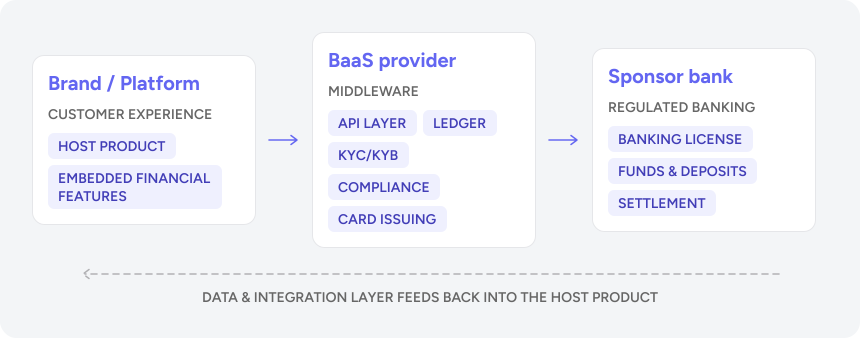
Although implementations vary, a typical Banking as a Service ecosystem includes three key participants:
- The platform or brand provides the customer experience and integrates banking features into its application.
- The BaaS provider supplies the APIs, middleware, compliance tooling, and integration layer that connects the platform with regulated banking infrastructure.
- The sponsor bank holds the banking license, manages customer deposits, settles transactions, and fulfills regulatory obligations required to deliver financial products.

Banking as a Service vs. embedded finance vs. open banking
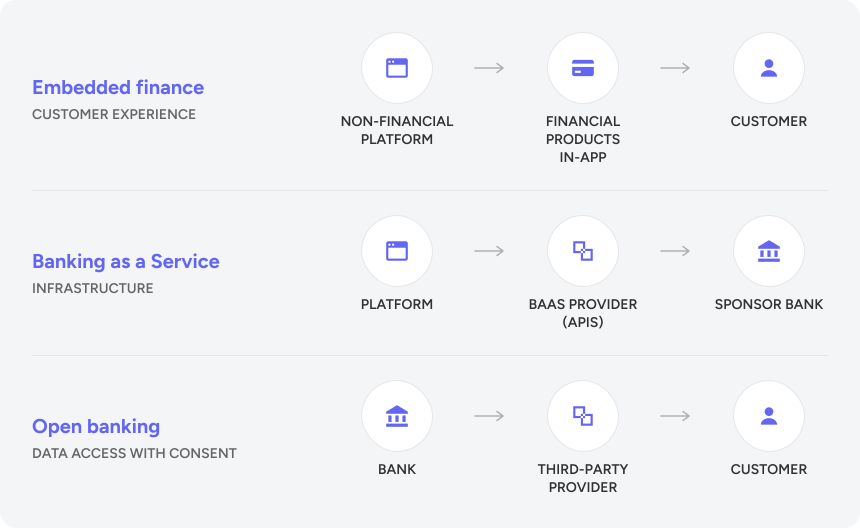
Banking as a Service (BaaS), embedded finance, and open banking are closely connected concepts, but they solve different problems. The distinction matters for businesses deciding how to introduce financial services into their products.
Embedded finance refers to financial services being built directly into non-financial platforms. For example, a marketplace may offer seller payouts, or a software platform may provide business accounts without requiring users to go to a separate bank.
Banking as a Service (BaaS) provides the foundation behind many of these experiences. It allows businesses to offer banking products by working with licensed banks and BaaS providers.
Open banking takes a different approach by focusing on access to financial data. Customers can authorize third-party providers to use their account information for services such as payment tools, account aggregation, and financial insights. Rather than delivering banking products, open banking creates new ways for businesses and customers to use financial information.
| Concept | What it is | Primary role |
|---|---|---|
| Embedded finance | Financial products integrated into a non-financial application | Customer experience |
| Banking as a Service (BaaS) | Licensed banking capabilities delivered through APIs | Infrastructure that powers embedded financial products |
| Open banking | Secure sharing of customer banking data through APIs | Data access with customer consent |
Although these concepts are closely related, they solve different problems. A company building an embedded finance solution may rely on BaaS to provide regulated banking services and, where appropriate, use open banking to access customers’ financial data. Together, they enable more connected financial experiences, but they are not interchangeable terms.
The BaaS architecture & how it works
A customer may see only a single application when opening an account, using a card, or making a payment, but the process relies on multiple components working together, including the platform, BaaS provider, and sponsor bank.
A typical Banking as a Service ecosystem consists of three main participants: the platform, the BaaS provider, and the sponsor bank.
The platform
The platform is the customer-facing application. This could be a retailer, SaaS company, marketplace, healthcare provider, or any other business embedding financial services into its product. Customers interact with the platform to open accounts, make payments, manage cards, or apply for financing. From their perspective, the financial services are part of the platform’s overall experience.
The BaaS provider
The BaaS provider connects the platform with the regulated banking system. It supplies the technology and operational services needed to deliver financial products while simplifying integration for the platform.
The capabilities depend upon the provider and can include:
- Account creation and management
- Payment processing
- Card issuing
- Transaction ledger services
- Customer onboarding and identity verification
- Transaction monitoring and fraud controls
- Compliance and reporting tools
Rather than integrating separately with multiple banking systems, the platform works through a single provider that manages these services.
The sponsor bank
The sponsor bank is a licensed institution that provides regulated banking services. It manages accounts, transactions, deposits, and compliance requirements while enabling the financial products customers access through the platform.
Transaction flow in BaaS
While implementations vary, the process generally follows the same pattern:
A customer initiates a financial action within the platform, such as opening an account or making a payment.
The platform sends the request to its BaaS provider.
The BaaS provider validates the request and performs the required onboarding, compliance, or payment processing activities.
The sponsor bank authorizes and processes the regulated banking service.
The result is returned to the platform, which updates the customer in real time.
Throughout this process, customers remain within the platform’s application, even as multiple organizations work together behind the scenes.
Key components of a BaaS platform
Each Banking-as-a-Service provider takes a slightly different approach, but most platforms are built around a common set of core capabilities.
| Component | What it does |
|---|---|
| API and integration layer | Connects the platform to banking services and keeps customer data synchronized |
| Core banking and ledger | Records balances, transactions, and account activity |
| Identity verification (KYC/KYB) | Verifies individuals and businesses before accounts are opened |
| Payments infrastructure | Supports transfers, Automated Clearing House (ACH) payments, wires, real-time payments, and card transactions |
| Card issuing | Enables businesses to issue physical and virtual payment cards |
| Compliance and fraud monitoring | Helps identify suspicious activity and supports regulatory requirements |
Building products with Banking as a Service
Banking as a Service allows organizations to embed a wide range of financial products into their digital experiences. The right solution depends on the business model, customer needs, and the outcomes the organization wants to achieve. Some businesses use BaaS to simplify payments, while others build entirely new financial products that create additional revenue streams and strengthen customer relationships.
Some of the most common use cases include:
Accounts & digital wallets
Businesses can offer customers branded checking or savings accounts, digital wallets, or stored-value accounts without becoming a bank. These products give users a single place to hold funds, make payments, and manage their finances within the platform.
For example, an accounting platform offers business checking accounts that allow customers to manage cash flow and reconcile transactions without switching between multiple applications.
Payments & money movement
BaaS allows businesses to add payment capabilities, fund transfers, and automated payouts within their platforms. This gives customers a simpler way to send and receive money without relying on separate payment workflows.
For example, a marketplace pays sellers as soon as an order is completed, eliminating the need for manual bank transfers or third-party payment portals.
Debit & virtual cards
Organizations can issue branded physical or virtual cards that connect directly to customer accounts. These cards support online purchases, employee spending, expense management, and customer rewards.
For example, a fleet management platform issues fuel cards that help businesses track spending, enforce purchasing policies, and simplify expense reporting.
Lending & financing
Businesses can offer financing at the point of need, giving customers access to credit without directing them to another lender. Depending on the use case, this may include working capital, installment loans, or buy now, pay later (BNPL) options.
For example, an e-commerce platform provides eligible merchants with working capital based on their sales history, helping them purchase inventory and grow their businesses.
Embedded payments
Payment capabilities can be integrated throughout the customer journey, allowing users to pay invoices, subscriptions, or service fees without leaving the application.
For example, a healthcare platform enables patients to schedule appointments, view bills, and make payments through a single portal.
Banking as a Service across industries
Although BaaS first gained traction in fintech, it is now being adopted across a wide range of industries.
Retail & e-commerce
Shopify offers merchants payment processing, business financing through Shopify Capital, and business banking tools within its platform.
Marketplace
Uber and Etsy enable drivers and
sellers to receive payouts through their platforms instead of relying on separate banking processes.
SaaS providers
Toast combines restaurant management software with payments, business accounts, and financing, giving customers access to financial services from the same platform they use to run their business.
Healthcare
CareCredit allows patients to
finance eligible healthcare expenses making financing available where care
is delivered.
Travel & hospitality
Airbnb and Booking.com process customer payments and distribute payouts to hosts through their platforms, reducing the need for manual payment workflows.
How a non-financial platform builds embedded finance
Launching an embedded financial product involves more than integrating banking capabilities into an application. Organizations must define the business model, select the right partners, and establish the processes needed to operate regulated financial services.
While every implementation is different, most projects follow a similar path.
Define the use case
The first step is identifying the problem the financial product is meant to solve. Some organizations want to simplify payments, while others are looking to improve customer retention, create new revenue streams, or offer financing at key points in the customer journey.
The use case shapes the type of financial products required and influences the technical and regulatory decisions that follow.
Choose the right partnership model
There are several ways to bring embedded financial services to market. Some organizations work with a Banking as a Service provider that connects them to a sponsor bank and provides the supporting technology. Others establish direct partnerships with licensed banks or work with fintech providers that offer specialized capabilities such as payments or card issuing.
The right model depends on factors such as the products being offered, the level of operational control required, regulatory obligations, and the organization’s internal resources.
Integrate banking capabilities into the platform
Once the partnership model is defined, financial features such as accounts, payments, cards, or lending can be added to the existing product experience. These services should fit naturally within the platform instead of feeling like a separate banking tool.
Plan for compliance early
A banking partner does not remove the platform’s compliance responsibilities. Teams still need to address areas such as customer verification, fraud controls, transaction monitoring, and recordkeeping as part of building the product.
Start with a focused offering
Most BaaS products begin with a specific customer need rather than a full set of financial services. A platform may start with payments or accounts, then introduce additional capabilities as the product gains adoption.
Compliance, risk & the realities of Banking as a Service
Adding financial services to a platform comes with new responsibilities. Teams need to consider a number of factors, such as customer verification, fraud prevention, data protection, and regulatory requirements, as part of product design.
A BaaS partnership works best when responsibilities are clear from the beginning. The platform, BaaS provider, and sponsor bank should agree on who manages each part of the service before launch.
Compliance is a shared responsibility
The sponsor bank is responsible for operating within banking regulations, but platforms are expected to support many of the day-to-day controls that keep financial services secure and compliant.
Who owns each activity should be clearly defined before a product goes live. Depending on the product, these responsibilities may include:
- Customer identity verification (KYC/KYB)
- Transaction monitoring
- Anti-money laundering (AML) controls
- Fraud detection and prevention
- Consumer protection requirements
- Data privacy and security
Managing third-party risk
A BaaS product rarely runs on a single provider. The platform, sponsor bank, BaaS provider, payment networks, and other vendors all play a role in delivering the service. Without clear ownership, issues can arise around service availability, security, and compliance.
Changing regulatory landscape
BaaS partnerships have received greater regulatory scrutiny as banks work with an increasing number of fintech companies. Sponsor banks remain responsible for overseeing these relationships and understanding how their partners handle customer data, transactions, and compliance obligations.
Building compliance into the product
Compliance cannot be treated as a final review before launch. Customer verification, fraud controls, recordkeeping, and disclosures need to be considered during product design.

Benefits of Banking as a Service
Banking as a Service enables organizations to expand beyond their core offerings by integrating financial products into the customer experience. When implemented strategically, it can create value for both the business and its customers.
New revenue opportunities
Generate additional revenue by offering services such as payments, cards, lending, or
business accounts.
Better customer retention
Keep customers engaged by enabling them to access financial services without leaving
the platform.
Improved customer experience
Bring financial services into existing digital experiences to reduce friction and simplify
everyday tasks.
Faster time to market
Launch financial products more quickly by building on existing banking infrastructure rather
than developing them from scratch.
Building a sustainable future of embedded finance
As embedded finance continues to reshape digital experiences, organizations have an opportunity to deliver greater value by bringing financial services closer to their customers. Success, however, depends on more than integrating banking capabilities into an application.
Building an embedded finance solution means making decisions that go beyond product development. Banking partnerships, regulatory obligations, and security all need to be considered from the start.
At 10Pearls, we work with financial institutions, fintechs, and digital platforms to design, build, and modernize embedded finance with custom fintech solutions. From defining the architecture to developing secure, customer-facing applications, we help organizations bring financial products to market with confidence.
FAQs about Banking as a Service
What is Banking as a Service (BaaS)?
Banking as a Service (BaaS) allows licensed banks to make regulated banking capabilities available to other businesses. Companies can integrate products such as accounts, payments, cards, and lending into their applications without obtaining a banking license.
How is Banking as a Service different from embedded finance?
Banking as a Service is the infrastructure that enables financial products to be delivered by non-bank businesses. Embedded finance solutions are the customer experience, where those financial products are integrated into a non-financial application or platform.
What is an example of Banking as a Service?
A software platform that allows businesses to open bank accounts, accept payments, or issue debit cards from within the application is a common example of Banking as a Service in action. The underlying banking services are provided by a licensed financial institution.
How does BaaS architecture work?
A BaaS solution connects three parties: the business offering the financial product, the BaaS provider, and the sponsor bank. Customers interact with the business’s application, while the banking infrastructure and regulated services are delivered behind the scenes.
Who is responsible for compliance in Banking as a Service?
A Banking as a Service partnership does not transfer all compliance responsibilities to the sponsor bank. The bank remains accountable for meeting regulatory requirements and platforms are expected to maintain controls that support the safe delivery of financial products.
What is a sponsor bank?
A sponsor bank is a licensed financial institution that allows businesses to offer regulated financial products without becoming banks themselves. It provides the banking license and delivers the regulated banking services behind the scenes.
Related blogs

Mobile app development
Real Estate App Development Guide
Real estate app development involves varying costs, timelines, features, and technical requirements. Explore key development factors, must-have features, and AI...

Mobile app development
In-House vs Outsource Mobile App Development: What’s Best?
Every mobile app starts with one decision: build in-house or outsource. We break down the real costs, tradeoffs, and the...

Mobile app development
Leading mobile app development companies to partner with in 2026
Discover the top mobile app development companies of 2026, leveraging AI, IoT, and innovative design to create future-proof solutions.

Mobile app development
Overcome AI integration hurdles in mobile app development
AI is reshaping how developers approach app design and functionality – influencing decisions around user experience (UX), functionality, and performance....

Mobile app development
Discover the impact of AI on mobile app development
Discover how AI is transforming mobile app development, its limits, and why human developers remain essential for strategic, creative problem-solving.

Mobile app development
Explore the cross-industry impact of AI mobile apps in 2025
Artificial intelligence is all set to redefine the digital landscape in 2025, particularly in mobile app development. Mobile apps are...

Mobile app development
The education sector has been notoriously slow to adopt new technology, but that’s changing fast, in no small part due...

Mobile app development
Brand loyalty now relies on mobile experience – here’s why
In this post, our custom software development experts will discuss the importance of mobile experience in enhancing brand loyalty and...